
TL;DR
A nursing shift is 15,000–20,000 steps on hard floors, and the foot doesn't fail at step one — it fails late, when tired muscles let the arch collapse and the heel pad shifts. So the priority is support first, cushioning second: a firm, semi-rigid arch support that holds up late into the shift, a deep heel cup to keep the heel pad centered, and cushioning that lasts the shift instead of bottoming out — all thin enough to fit your work shoes or clogs. A custom 3D-printed insole tunes arch firmness, heel cup, and cushioning to your own foot and can be reprinted from the same design. Insoles can reduce fatigue and improve comfort for many people; they're not a cure, and pain that persists belongs with a clinician.
Key takeaways
- A shift is 15,000–20,000 steps on hard floors — the foot fails late, so support that lasts matters more than soft cushioning that bottoms out.
- Support first, cushioning second: firm/semi-rigid arch support + deep heel cup, then lasting cushioning.
- Must fit work shoes / clogs — a bulky insole won't go in; custom can be tuned to the shoe.
- Custom levers: arch height/firmness, deep heel cup, cushioned zones, durable TPU, work-shoe-friendly profile — per foot.
- Ergono3D = parametric, per-foot, iterable STL: you pay for the design with credits (see pricing) and print it yourself (filament, printer, and time). Comfort and fatigue help — not a cure; persistent pain → clinician. Break in gradually.
Searches for insoles for nurses and insoles for standing all day usually come from people whose feet are fine in the morning and wrecked by the end of a long shift. That timing is the whole story. Standing and walking all day on hard hospital floors — and the same goes for retail, hospitality, teaching, and factory work — loads the foot for ten or twelve hours straight, and the insole that helps looks different from a running or everyday insole. This guide covers what a shift does to the foot, what an all-day work insole actually needs, and where a durable custom 3D-printed insole fits.
What a 12-hour shift does to the foot.
The defining fact: the foot doesn't fail at step one. It fails late, after hours of standing and walking on an unforgiving floor.
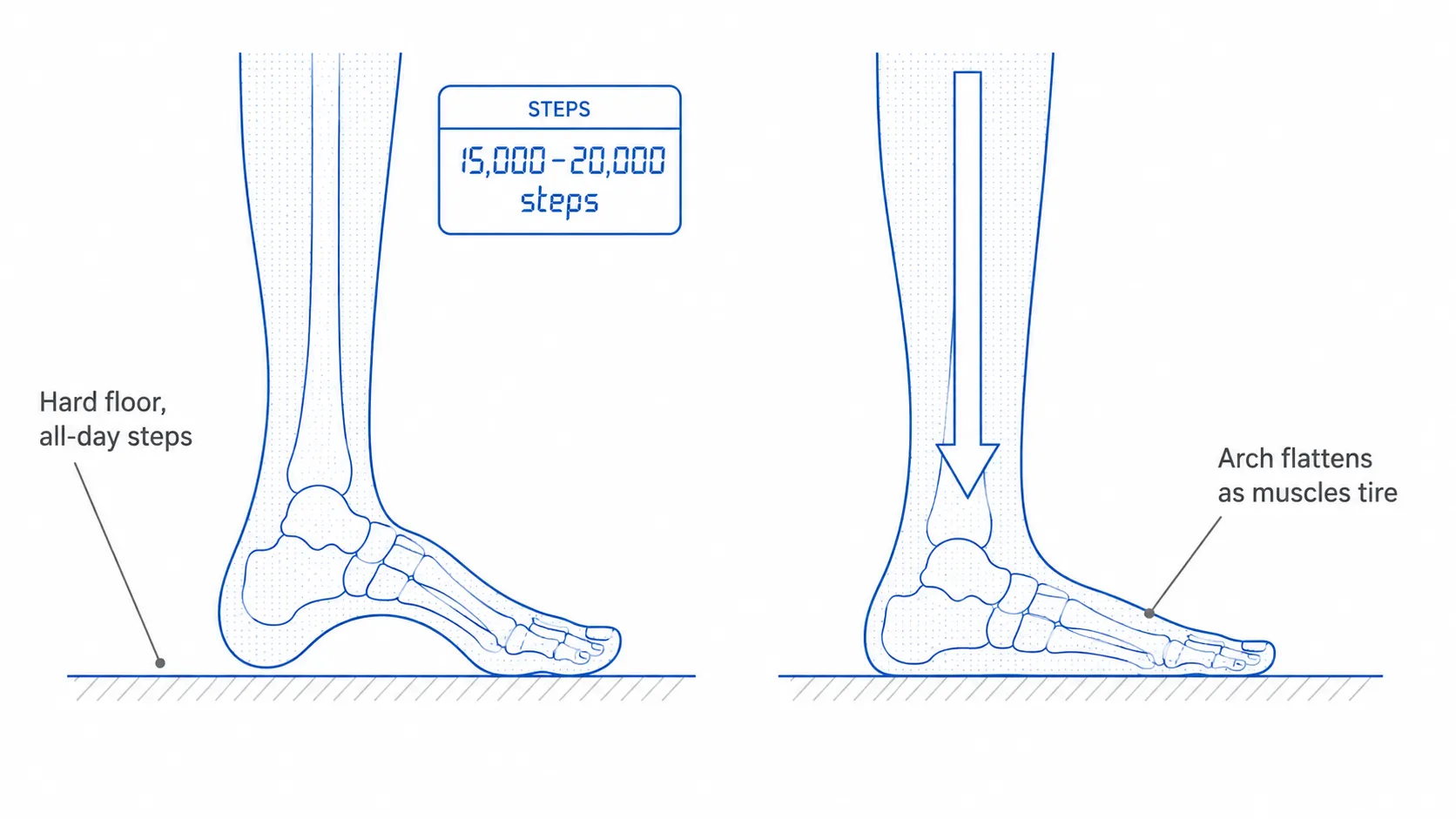
Step count and hard floors. Nurses routinely hit 15,000–20,000 steps a shift, almost all of it on hard tile or polished concrete that gives nothing back. The same is true for warehouse and factory floors, shop floors, and school hallways. Every one of those steps sends impact up through the heel and forefoot, and over a full shift it adds up to far more loading than a typical day on your feet.
Late-shift fatigue. The muscles that hold the arch up are working the entire time, and like any muscle they tire. Early in the shift they keep the foot's structure where it belongs. As the hours add up they fade, and the arch starts to flatten under body weight because the muscles can no longer hold it. That is why feet feel fine at lunch and sore by the end — the support quietly gave way as the day wore on.
Arch collapse and the heel pad. When the arch flattens late in a shift, the foot rolls inward and lengthens, which strains the soft tissue along the bottom of the foot and the inside of the arch. At the same time the heel fat pad — the body's own built-in cushion under the heel bone — spreads and shifts under hours of repeated impact, so the heel loses some of its natural padding exactly when it is taking the most pounding. The ache that shows up in the arch and heel at the end of a shift comes largely from these two things happening together.
Put together, an all-day standing shift asks for support that lasts first — structure that holds the arch up and the heel centered through the back half of the shift — rather than the soft, plush feel that suits a short walk. That single difference drives the whole design.
What a nurse's insole actually needs.
Map the all-day load to design and the priorities are clear — and they put support before softness.
A work insole that holds up across a long shift tends to combine:
- Firm, semi-rigid arch support — structure that resists collapse when the arch muscles tire late in the shift, so the foot keeps its shape to the end.
- A deep heel cup — to cradle and center the heel fat pad under long-term load, keeping the body's own cushion where it does the most good.
- Lasting cushioning — shock absorption under the heel and forefoot that is still doing its job at the end of the shift, not compressed flat hours earlier.
- A work-shoe-friendly fit — slim enough to go into a clog or work sneaker, because the best insole in the world is useless if it won't fit the shoe you actually wear.
The trade-off worth naming is the one that catches people out: support first, cushioning second. A very soft, cushioned insole feels wonderful in the first hour and then compresses, so late in a long shift — exactly when tired arch muscles need help most — it offers little support. Foot specialists generally advise getting the support right first, then adding durable cushioning on top. As occupational-insole brands like PowerStep and Superfeet frame it, a firm supportive base with a deep heel cup is what carries an all-day standing worker through the shift; the cushioning rides on top of that, it does not replace it.
The custom design levers for an all-day insole.
A custom work insole is custom because these are tuned to your foot and your shoe, not picked from a size bucket.
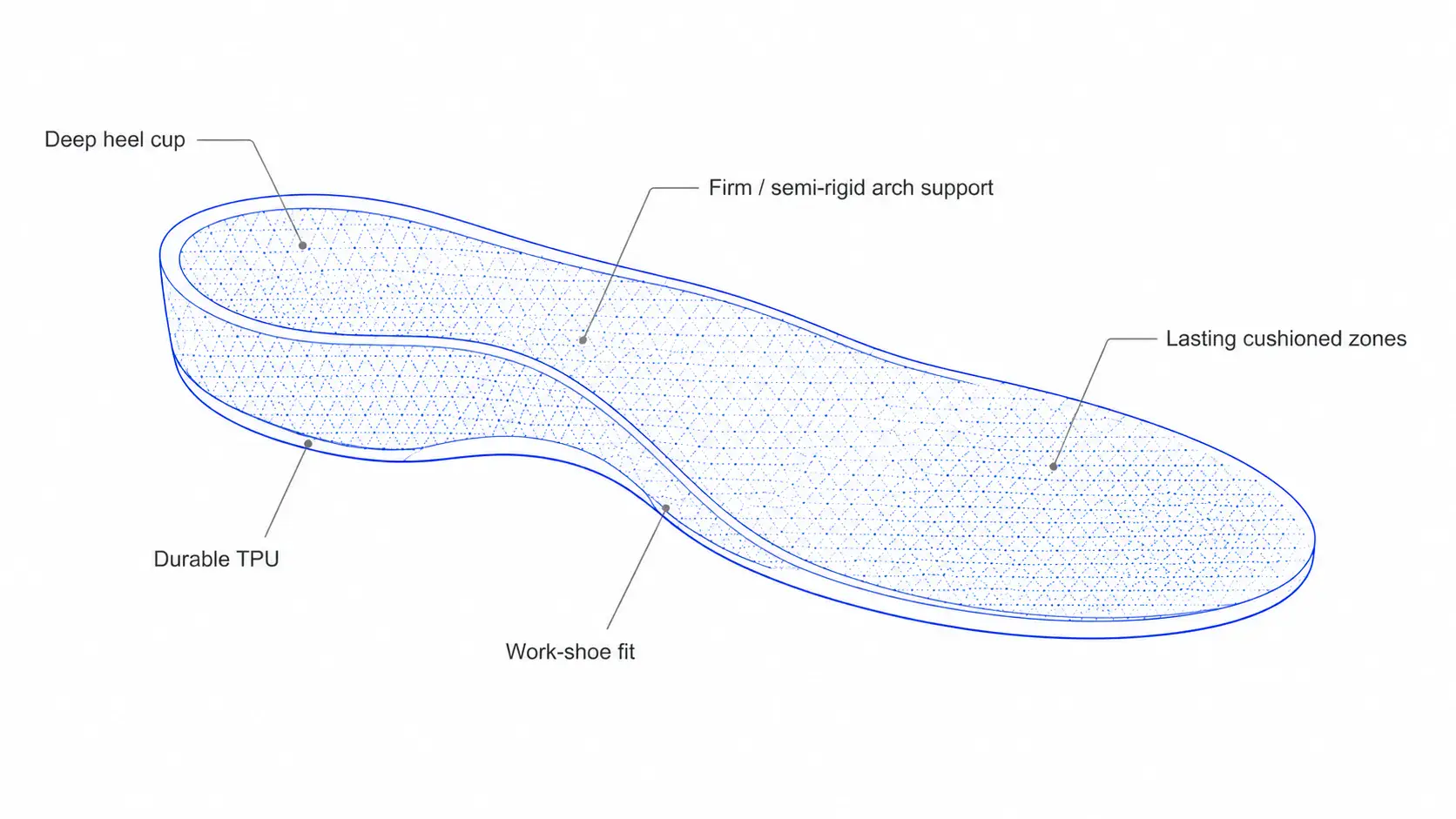
Ergono3D is a guided, parametric 3D printed custom insole design platform. For an all-day standing shift, the levers that matter are:
- Arch height and firmness — matched to your arch and set firm and semi-rigid, so the support holds late into the shift instead of giving way as the muscles tire.
- Heel cup depth — deeper to cradle the heel fat pad and keep it centered under the long-term pounding of a hard floor.
- Cushioned zones — durable shock-absorbing pads at the heel and forefoot, tuned to last the shift rather than feel maximally plush on day one.
- Durable TPU and a slim work-shoe profile — a durometer and thickness chosen so the insole survives daily wear and still slides into the clog or work sneaker you stand in.
Every control is set independently per foot, and the output is a print-ready STL. For how each parameter behaves, see understanding insole design parameters. The iteration angle applies here too: dial in the arch firmness and heel cup, wear them for a few shifts, then adjust the design or reprint the same one.
By foot type.
The all-day setup still starts from your foot type — and a long shift gives whatever your foot does plenty of time to do it.
Underneath the all-day needs is foot type. A flat, low-arched foot tends to overpronate, and standing for ten or twelve hours gives the arch many hours to fatigue and roll inward, so firm medial arch support and a deep heel cup are the priority — see custom insoles for flat feet. A high-arched foot is more rigid and absorbs impact poorly, so it tends to need the arch gap filled plus lasting cushioning under the heel and ball to soften all those hard-floor steps — see custom insoles for high arches. The pillar piece, why one insole design does not fit every activity, makes the general case: match the foot first, then the demand.
Overpronation is worth a careful word. It is common, and it tends to show up more on a long standing shift simply because the foot has so many hours to fatigue — but supporting it with a tuned arch is a comfort-and-support measure, not a medical treatment. If the arch or heel ache is sharp, persistent, or feels like a specific problem rather than ordinary end-of-shift soreness, that is a question for a clinician; our note on insoles and plantar-fasciitis-type heel and arch pain explains where supportive design may help and where it does not.
Pre-made versus custom for long shifts.
Pre-made work insoles are good and enough for many people. The custom case is exact fit and reprinting from the same design.
| Option | What you pay | Per-foot tuning | Replace when worn | Best fit for |
|---|---|---|---|---|
| Stock shoe insole | Included | No | Wears fast | Short shifts — upgrade for all-day standing |
| Drugstore work insole (e.g. Dr. Scholl's Work) | Brand retail price | No | Buy another | Casual relief; softer, cushioning-led |
| Pre-made support insole (PowerStep, Superfeet Work) | Brand retail price | No (arch bucket) | Buy another | Many on-their-feet workers; firm support; first upgrade |
| Ergono3D custom 3D printed insole | Design credits + your print* | Yes (per foot, parametric) | Reprint from the same design | Off-bucket arches, asymmetry, tight work shoes, reprinting when worn |
*The design is paid for with Ergono3D credits (see current pricing); an STL you have already paid for can be downloaded again at no charge. The print is on you: TPU filament (estimate it from your slicer's weight estimate and your filament price), printer, failed prints, electricity, top cover, and your time. Brand prices vary by country and store. How long any insole lasts depends on material, body weight, and how many hours a week you stand on it, so treat lifespan as a range rather than a guarantee.
For someone on their feet all day, the custom argument is exact fit per foot — including a profile that goes into the specific shoe you work in — plus reprinting the same design when a pair wears down, or adjusting a parameter first. For the general worth-it case, see are custom insoles worth it?
How to 3D print a durable work insole.
Same loop as any Ergono3D insole, with the all-day emphasis on firm support, durability, and a profile that fits your work shoe.
- Answer the guided survey. Foot type and arch height, any left-right difference, the shoe you work in, how long you stand, and where the ache shows up late in a shift.
- Tune the all-day parameters. A firm, semi-rigid arch support, a deep heel cup, lasting cushioned zones, and a slim work-shoe profile — per foot.
- Export the STL. Ergono3D exports a print-ready file for each foot.
- Print durable and work-shoe-friendly. Use a durable TPU and adequate infill so the insole holds its support through a long shift and fits inside your clog or work sneaker; print on any FDM printer that handles flexible filament.
- Break in gradually, then iterate. Wear them an hour or two at home first and ramp up over several days; then adjust arch firmness, heel cup, or cushioning and reprint if needed.
The full print walkthrough — slicer settings, TPU handling, finishing — is in how to make your own custom insoles at home. The same per-foot approach applies to other long-duration activities, including insoles for hiking and insoles for running.
Answer a short guided survey about your feet and the shoe you stand in. Ergono3D turns it into adjustable parameters — firm arch support, deep heel cup, lasting cushioned zones — per foot, and exports a print-ready STL. Free preview available. For pain that persists, see a clinician.
Breaking them in, and when to see a clinician.
A new supportive insole changes how your foot sits. That is the point — but it means you ease into it, and you keep an eye on the signals that are not about break-in.
Break them in gradually. A firm, supportive insole repositions the foot, and the muscles and joints need a few days to adapt. Do not debut a new orthotic insole on a 12-hour shift. Wear it an hour or two at home first, then a few hours, and build up to a full shift over several days. A little new-insole awareness in the arch as you adjust is normal and usually settles; pushing straight to a full shift on day one is the fastest way to make a good insole feel bad.
What break-in is not. Some sensations are not part of adjusting and are worth respecting. Numbness or tingling, swelling, a hot spot turning into a blister, or pain that is sharp, that persists past the adjustment period, or that gets worse are signals to stop and reassess — not to push through. Ease back, recheck the fit, and if it continues, see a clinician.
Where Ergono3D fits, plainly. A custom work insole is a supportive design that can reduce how beaten-up the feet feel and improve comfort across a long shift for many people. It is not a treatment, it does not cure foot pain, and it cannot promise a fatigue-free shift or fix an underlying foot problem. Treat ache as information: ordinary end-of-shift soreness is one thing, but a specific, persistent, or worsening pain — or numbness or swelling — should be assessed by a clinician or podiatrist, not managed with another insole.
FAQs about insoles for nurses.
Do insoles help nurses on their feet all day?
For many people, yes — a supportive insole with firm arch support, a deep heel cup, and lasting cushioning can reduce how beaten-up the feet feel late in a long shift and improve all-day comfort. What an insole cannot do is cure foot pain or guarantee a fatigue-free shift. Treat it as a comfort and support upgrade, not a treatment. Pain that persists or worsens, or numbness and swelling, should be assessed by a clinician.
What's the best type of insole for nurses?
Support first, cushioning second. The combination that lasts a 12-hour shift is a firm, semi-rigid arch support that resists collapse when foot muscles tire, a deep heel cup that keeps the heel pad centered under long-term load, and lasting cushioning that does not bottom out late in the shift — all in a slim profile that still fits your work shoe or clog. Plush softness alone tends to fail late in the shift.
Soft cushioned or firm support — which is better for long shifts?
Honestly, firm support that lasts. A very soft, cushioned insole feels great in the first hour and then compresses, so by late in a long shift it offers little support exactly when tired arch muscles need it most. Foot specialists generally advise support first and cushioning second: a firm, semi-rigid arch with a deep heel cup, plus cushioning that is durable rather than maximally plush. The cushioning matters, but it should sit on top of real support, not replace it.
Will work insoles fit in my clogs or work sneakers?
They have to, or they are no use — a bulky insole simply will not go into a clog or a slim work sneaker. Many nursing shoes have a removable factory insole you take out first to make room. A custom insole has an advantage here: the profile and thickness can be tuned to the shoe you actually work in, so you get the support without overstuffing the shoe. If in doubt, design around the tightest pair you wear.
What about insoles for flat feet on long shifts?
Flat or low-arched feet often overpronate, and standing all day gives the arch many hours to fatigue and roll inward, so firm medial arch support and a deep heel cup are the priority. The right arch height is the one matched to your foot, not a generic bucket — which is exactly what custom tuning is for. Our flat-feet guide covers what to customize; if a specific foot problem is involved, a clinician can advise on what your feet need.
How does Ergono3D make a custom work insole?
Ergono3D is a custom insole design workflow. You answer guided questions about foot type, arch height, the shoe you work in, and where the ache shows up late in a shift; Ergono3D turns those into parametric controls — firm arch support, a deep heel cup, lasting cushioned zones, durable TPU, and a slim work-shoe profile — set per foot, and exports a print-ready STL. You print it durable, break it in gradually over a few days, and can return to re-parameterise and reprint when a pair wears down.
Related: insoles for hiking · insoles for running · why one insole does not fit every activity.