
TL;DR
No single insole design fits every activity, because running, walking, long standing, and court sports load the foot in genuinely different ways. A general-purpose insole averages geometry, stiffness, and pressure profile into a compromise — tolerable everywhere, correct nowhere. The fix is to start from your main activity and tune a small set of interdependent variables: arch support profile, heel cup depth, forefoot support, regional stiffness, and sidewall integration.
That is where a parametric approach helps, letting those parameters move together instead of forcing one fixed template. Ergono3D sits on the custom-design side: guided inputs and parametric design generate a printable STL tuned to your use case — a design tool, not a diagnosis or treatment.
Key takeaways
- Activities aren't average. Running is repetitive vertical impact; long standing is mostly static load; court sports drive force sideways — each is a distinct mechanical problem.
- General-purpose means compromise. Averaged geometry, moderate stiffness, and a neutral pressure profile feel acceptable across activities and correct in none of them.
- A small set of variables shifts with use. Arch support profile, heel cup depth, forefoot support, regional stiffness, and sidewall integration are the levers that should change by activity.
- Mismatch feels subtle, not dramatic. The first mile or first ten minutes feels fine, then support goes vague or unstable exactly when it matters.
- Start from how you move. Stronger support isn't universally better; support matched to the activity is. Ergono3D delivers the custom side via guided inputs and parametric design — a design tool, not a diagnosis or treatment.
Most conversations about insoles stop at arch height, cushioning, and brand. That framing skips the part that actually matters. A foot running a 10K, a foot standing on concrete for an eight-hour shift, and a foot cutting sideways on a basketball court are not doing the same job. They load the ground in different ways, tire out on different timelines, and want different things from what sits under them. An insole that feels right in one setting can feel vague, intrusive, or unstable in another. So the question isn't really whether an insole has support. It's whether the kind of support matches what you actually do in it.
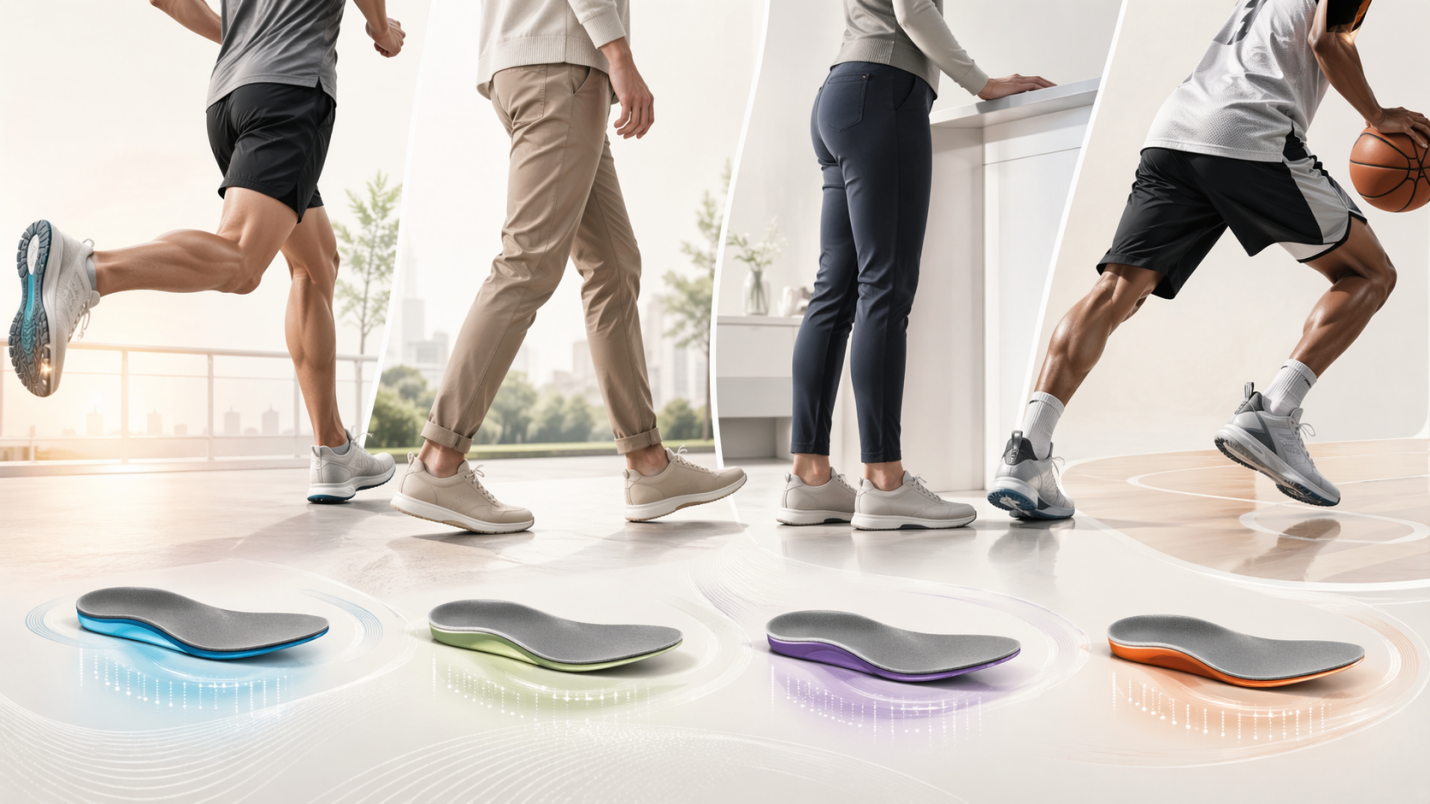
Why a general-purpose insole often falls short.
Broad acceptability has a cost. It usually translates into averaged geometry, moderate stiffness, and a neutral pressure profile.
General-purpose insoles are made to feel acceptable to as many people, in as many shoes, across as many situations as the designer can cover. That's a reasonable goal. It also has a cost. Broad acceptability usually translates into averaged geometry, moderate stiffness, and a neutral pressure profile. Which is another way of saying compromise.
Real activities are not average. Running is repetitive vertical impact and a clean heel-to-toe rollover. Long standing keeps the foot mostly static, with limited movement variation across hours. Court sports drive the foot sideways, with hard stops and direction changes. Plantar pressure profiles measured during these activities differ accordingly[1]. Those are genuinely different mechanical problems, and the single averaged insole you get off the shelf can feel tolerable in all three and correct in none of them.
How different activities stress the foot.
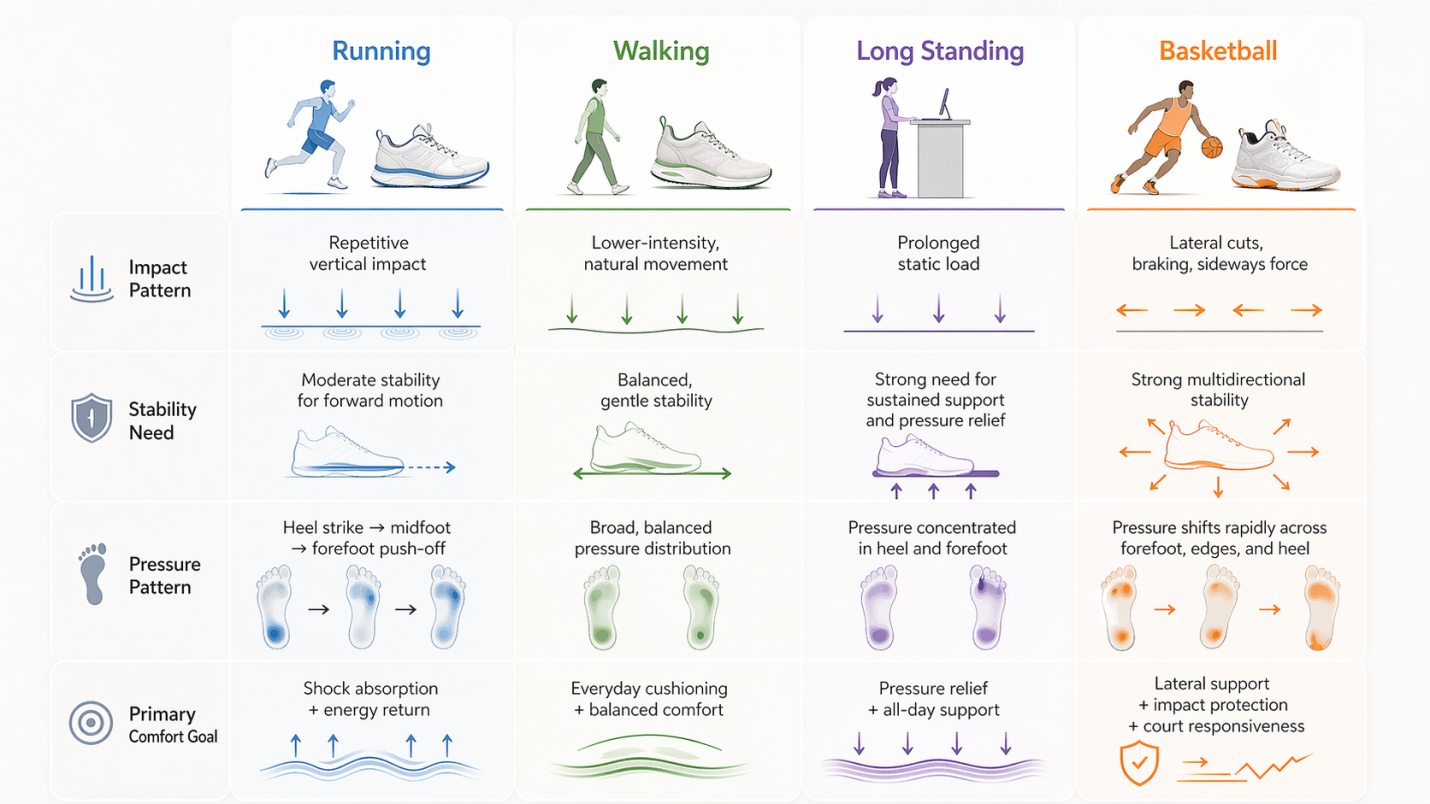
Four common activities, side by side. Each has its own mechanical signature, its own main demand on the insole, and its own way of feeling wrong when the design doesn't fit.
Running
Running is repetitive vertical impact stacked on top of a structured gait cycle. Each stride moves through initial contact, rollover across the midfoot, and a forefoot push-off, and that sequence repeats thousands of times in a session[2].
The insole's job is to cooperate with the rollover, support the arch through mid-stance, and help keep the foot organized as it tires. When the design is wrong, runners tend to describe a similar experience. The first few minutes feel fine. Then something goes vague as the run continues, and the support that was there at the start can fade exactly when rollover and fatigue start to matter.
Walking and Daily Use
Walking is lower intensity but much higher duration. The goal isn't performance, it's tolerance. What most people actually want is an insole that feels natural, doesn't announce itself, and stays comfortable across a full day of mixed walking, standing, and sitting.
An aggressive sport-oriented geometry often falls short in daily wear not because it's wrong in principle, but because it's doing too much. It pushes on the foot in ways a casual user never asked for. A subtler arch profile with more balanced stiffness tends to work better: supportive enough to matter, quiet enough to disappear.
Long Standing
Long standing isn't walking in slow motion. It's a separate mechanical problem. The foot is mostly static, movement variation is limited, and discomfort can build as the same regions are loaded repeatedly over time[3].
What the insole needs to do here is spread load and help delay the build-up of discomfort. A design borrowed from a sport insert often feels supportive for the first ten or fifteen minutes and slowly turns tiring. What was helpful in a 45-minute workout can become intrusive across eight hours.
Basketball and Court Sports
Court sports load the foot in directions most running-oriented designs don't plan for. Lateral cuts, hard landings, braking, quick changes of direction. Force moves sideways through the foot, not just up and down. Research on cutting and acceleration tasks shows that athletic direction changes can alter forefoot loading patterns in ways that straight-line gait does not capture[4].
The insole here needs to help contain the heel, engage the sidewalls (the raised edges that hold the foot in place), and stay responsive through push-off. A straight-line design can feel fine jogging up the court, then feel less stable the moment the player plants and cuts. The support was there. It just wasn't in the direction it was needed.
What should actually change in the design.
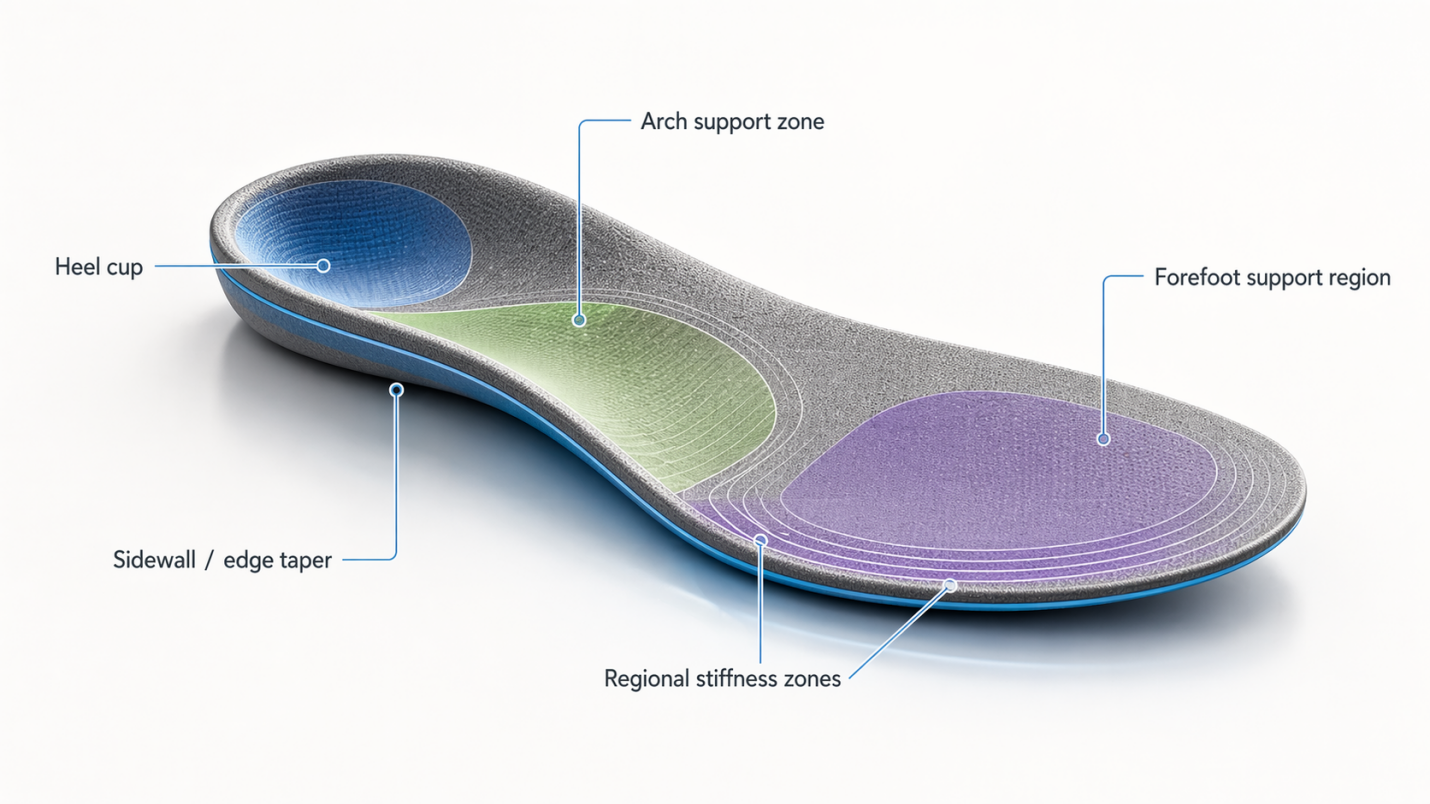
Activity differences map onto a small set of design parameters that can, and often should, shift with the use case.
This is where a parametric approach earns its keep. It lets those parameters move together instead of forcing you to pick one fixed template. For a deeper walk-through of each variable, see understanding insole design parameters.
Arch Support Profile
Arch support is more than a height number. It also involves where along the foot the support appears, how gradually it rises, and how far forward or back it extends[5]. A runner in mid-stance benefits from a profile that cooperates with rollover. A long-standing user often does better with a longer, gentler support zone that spreads load rather than concentrating it in one spot.
Heel Cup Depth
A deeper heel cup centers the rearfoot and adds stability, which can help in lateral sports and on uneven terrain. In casual daily wear, the same depth may feel restrictive. The right depth depends on how much rearfoot control the activity actually needs.
Forefoot Support
Forefoot support shapes push-off feel and influences pressure under the metatarsal heads. Runners and court athletes lean on it for responsiveness. Standing users care less about push-off and more about keeping pressure from concentrating in the same spot over hours.
Regional Stiffness
Regional stiffness is another variable worth naming out loud. The midfoot, heel, and forefoot rarely benefit from the same stiffness. A well-matched insole can firm up where control is needed and soften where impact or pressure concentrates[6]. Uniform stiffness is easier to manufacture, but in our experience it's often a compromise. Material choice plays in here too — see our DIY 3D-printing guide for how TPU hardness expresses those stiffness changes underfoot.
Sidewall and Edge Integration
How the insole sits inside the shoe matters too. Sidewall height affects how securely the foot is held. Edge taper decides whether the insole feels clean or bulky underfoot. These details often decide whether a technically correct design actually feels right on your foot.
These parameters aren't a checklist of features. They're interdependent variables that tend to move together as the use case changes.
What it feels like when the design is wrong.
Mismatches rarely feel dramatic. They feel subtly wrong, and they show up over time.
A runner using an insole built around standing comfort often reports a similar pattern. The first mile feels fine. Then the support goes quiet exactly when rollover and fatigue start to matter. A long-standing user in an aggressive sport insert may feel supported for a short window and slowly get worn down as the arch keeps pushing back. A basketball player in a running-oriented design may feel fine jogging between plays, and then feel less stable the moment they plant hard and change direction.
None of these insoles are poorly built. They're solving the wrong problem for the person wearing them.
Match the insole to how you move.
A more useful way to choose an insole is to start from the use case rather than the specs sheet. Stronger support isn't universally better. Support that matches the activity often does more.
If you're running, what matters is repetitive load and how the insole cooperates with gait progression. If you stand all day, it's pressure distribution and long-duration tolerance. If you play on a court, it's lateral stability, heel containment, and responsive push-off. If your day is mostly walking and casual standing, you probably want something that quietly disappears under the foot while still doing its job.
Once the main activity is clear, the variables that matter (arch profile, heel cup, forefoot response, regional stiffness, sidewall) can be tuned toward that use case instead of averaged across all of them. If you're starting from scratch, the free measurement tool is the fastest way to get the basic measurements in.
Below are deeper, single-topic guides — by activity and by foot type. Each one covers what to customize, how it differs from a pre-made template, and where Ergono3D fits.
Start with your main activity.
The better question is not whether an insole has "more support." The better question is whether the support logic matches how you actually use it.
With Ergono3D, you can start from your main activity, foot input, and fit needs, then generate a more specific 3D-printable insole starting point.
Common questions about activity-specific insoles.
Why does a general-purpose insole often fall short?
General-purpose insoles are made to feel acceptable to as many people, in as many shoes, across as many situations as possible. That broad acceptability usually translates into averaged geometry, moderate stiffness, and a neutral pressure profile — which is another way of saying compromise. The single averaged insole can feel tolerable across activities and correct in none of them.
How do running and long standing differ as demands on an insole?
Running is repetitive vertical impact and a clean heel-to-toe rollover, so the insole needs to cooperate with the rollover, support the arch through mid-stance, and keep the foot organized as it tires. Long standing keeps the foot mostly static with limited movement variation, so the insole needs to spread load and help delay the build-up of discomfort over hours.
What does an insole need to do for court sports like basketball?
Court sports drive the foot sideways, with lateral cuts, hard landings, braking, and quick changes of direction, so force moves sideways through the foot rather than just up and down. The insole here needs to help contain the heel, engage the sidewalls that hold the foot in place, and stay responsive through push-off.
Which design variables should change with the activity?
Activity differences map onto a small set of interdependent parameters: arch support profile, heel cup depth, forefoot support, regional stiffness, and sidewall and edge integration. A parametric approach lets those parameters move together toward the use case instead of forcing one fixed template.
Choose your main activity, enter a few basic measurements, and preview the insole Ergono3D generates around your use case. Free preview — 5 credits, no card required.
Sources cited.
- Orlin MN, McPoil TG. Plantar pressure assessment. Phys Ther. 2000;80(4):399–409. ↩
- Novacheck TF. The biomechanics of running. Gait Posture. 1998;7(1):77–95. ↩
- Speed G, Harris K, Keegel T. The effect of cushioning materials on musculoskeletal discomfort and fatigue during prolonged standing at work: A systematic review. Appl Ergon. 2018;70:300–314. ↩
- Queen RM, Haynes BB, Hardaker WM, Garrett WE. Forefoot loading during 3 athletic tasks. Am J Sports Med. 2007;35(4):630–636. ↩
- Kogler GF, Solomonidis SE, Paul JP. Biomechanics of longitudinal arch support mechanisms in foot orthoses and their effect on plantar aponeurosis strain. Clin Biomech. 1996;11(5):243–252. ↩
- Cheung JT, Zhang M. Parametric design of pressure-relieving foot orthosis using statistics-based finite element method. Med Eng Phys. 2008;30(3):269–277. ↩