TL;DR
High arches are the mirror image of flat feet. Because the midfoot is lifted and rigid, it barely shares the load, so pressure concentrates on the heel and the ball of the foot and the foot absorbs shock poorly. A high-arch insole needs to fill the gap under the arch for contact, cushion the heel and ball where pressure piles up, and use a deep heel cup to stabilize the heel and limit the outward roll — not the firm anti-collapse support a flat foot needs. Ergono3D tunes arch contact, cushioning, heel cup, and met pad per foot as a print-ready STL. Insoles support a high-arched foot; they do not cure it — and a new or worsening high arch can signal a nerve problem and should be checked.
Key takeaways
- High arches are the opposite of flat feet: a lifted, rigid midfoot, pressure on the heel and ball, poor shock absorption, and a tendency to roll outward (supination).
- The insole's job is arch contact + cushioning + a deep heel cup — fill the gap, pad the high-pressure zones, stabilize the heel. Not firm anti-collapse support.
- Levers: arch contact height, heel cup depth, met pad, and cushioned (often softer or zoned) TPU — set per foot.
- Ergono3D = parametric, per-foot, iterable STL: you pay for the design with credits (see pricing) and print it yourself (filament, printer, and time).
- Red flag: a new, worsening, or one-sided high arch — or foot drop, weakness, or dragging — can be neurological. See a clinician.
Searches for custom insoles for high arches usually come from people who have learned that "more arch support" is not the same as the right support. A high-arched foot does not need to be propped up higher — it is already high. It needs the space under the arch filled so the midfoot shares the load, and it needs cushioning where the pressure actually lands. This guide explains what a high arch needs, how that differs from a flat foot, and where a parametric custom workflow like Ergono3D fits.
What a high-arched foot actually needs.
Start with the mechanics, because they are the opposite of the flat-foot case — and that flips what the insole has to do.
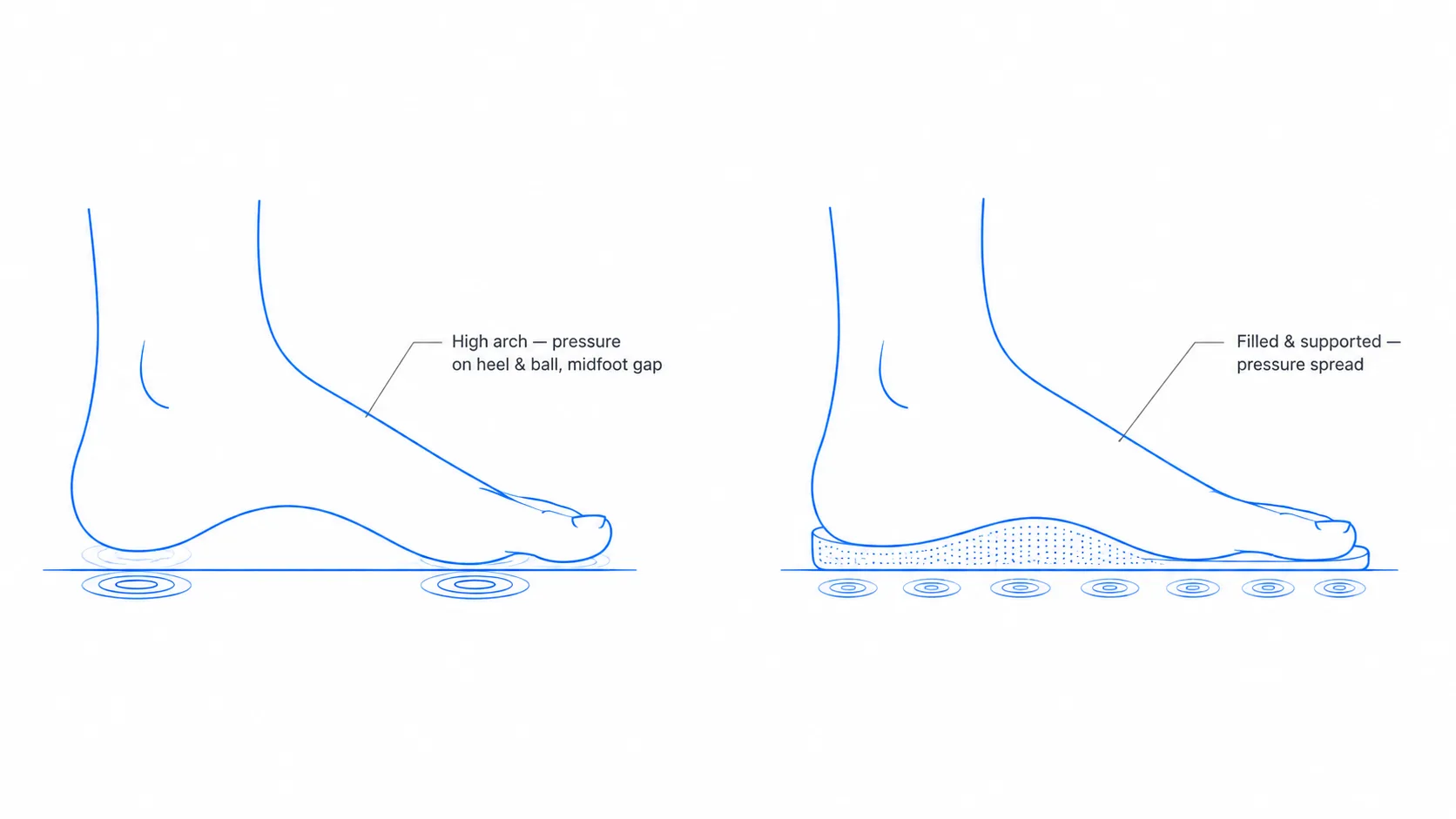
In a high-arched foot (pes cavus) the medial arch is tall and relatively rigid, so the middle of the foot is lifted off the ground. With the midfoot out of the picture, body weight has nowhere to go but the two ends — the heel and the ball of the foot. That concentration of pressure is why high-arched feet are prone to ball-of-foot pain, heel soreness, and calluses in those spots. A rigid high arch also absorbs shock poorly, because a springy midfoot is part of how a foot normally dissipates impact.
A high arch also tends to roll the foot outward — supination, or under-pronation — which shows up as wear on the outer edge of the shoe and can feel like instability on uneven ground. This is the opposite of the inward collapse a flat foot experiences.
So the insole's job is different from what a flat foot needs. It is not to hold up an arch that is collapsing — the arch is already high and is not collapsing. It is to fill the gap under the arch so the midfoot makes contact and shares the load, cushion the heel and ball where pressure concentrates, and stabilize the heel with a deep cup to limit the outward roll. Contact and cushioning matter more here than aggressive lift; for background, see Cleveland Clinic's overview of pes cavus.
Where pre-made high-arch insoles run out.
Off-the-shelf high-arch insoles are a reasonable first step, and many people do fine with one. The limit is in how exactly they can match a specific high arch.
Pre-made high-arch insoles from brands like Tread Labs, Aetrex, Powerstep, and Dr. Scholl's offer a few arch heights — often including an "extra high" option — and add cushioning under the heel and forefoot. For a high-arched foot that lands close to one of those buckets, that is genuinely useful and inexpensive. It is the right place to start.
The template runs out of reach in predictable places for a high arch specifically:
- It cannot match the exact arch contour, so the gap under the arch may be only partly filled — leaving the midfoot still under-loaded.
- It cannot place cushioning precisely under the heel and ball where one specific foot concentrates pressure.
- It cannot handle left-right difference, and a high arch is often higher on one foot than the other.
- It cannot tune a met pad or zone the softness for forefoot pressure that is common with high arches.
- It cannot be iterated — if the arch contact feels slightly off after wearing it, the next step is another off-the-shelf model, not an adjustment.
That is the gap behind searches like extra high arch insoles and custom insoles for high arches: the wearer has found that "the highest available" is not the same as "shaped to this arch." For the broader argument, see why custom insoles matter: a look at the science.
The custom design levers for high arches.
These are the same parameters used everywhere on the platform — but for a high arch they are set quite differently than for a flat foot.
Arch contact height
The core lever, and the one most often misunderstood. The goal is not to push a high arch higher — it is to bring the support surface up to meet the arch so the gap is filled and the midfoot finally shares load. Matched to the wearer's actual arch contour, this is what takes pressure off the overloaded heel and ball. Set too low it does nothing; set as a generic "high" it can jam against a rigid arch. Tuning it to the foot is the whole point.
Cushioning and zoned TPU
Because a high-arched foot absorbs shock poorly and concentrates pressure on the heel and ball, cushioning matters more here than for a flat foot. That can mean a softer TPU overall, or zoning — firmer through the arch contact for support, softer under the heel and ball for shock absorption. This is where high arches diverge most from flat feet, which generally want a firmer shell.
Heel cup depth and met pad
A deep heel cup cradles the heel, stabilizes it, and helps limit the outward roll that comes with a high arch. A metatarsal pad, placed just behind the ball of the foot, lifts and spreads the metatarsal heads to relieve the forefoot pressure that high-arched feet often feel. Both can be set per foot.
Some give, not rigidity
A high-arch insole should support without being rigid like a board — it needs to move a little with the stride. In parametric terms that is a combination of TPU hardness, thickness, and infill density. For how those behave, see understanding insole design parameters.
High arches and running, standing, and sport.
Activity amplifies the high-arch pattern — more impact, more repetitions, more outward roll.
High-arched runners often look for high-arch running insoles or insoles for supination. Two things stand out: the foot absorbs impact poorly, so repetitive running load is felt more sharply at the heel and ball; and the foot tends to supinate, rolling outward, which often shows as wear on the outer edge of the shoe. A supportive, cushioned insole that fills the arch and pads the high-pressure zones can help some high-arched runners manage that load — though, as always, individual response varies and pain is a reason to stop and get assessed, not to add more insole.
For standing and walking the priority shifts toward steady contact and cushioning over a long day, rather than impact. Across activities, the common thread is that a high-arched foot benefits from the support being matched to it — which is the whole argument of the pillar on why one insole design does not fit every activity. With a parametric workflow, a "running" set and an "all-day" set are two parameter choices from the same foot profile.
Pre-made, Ergono3D custom, or clinical.
The decision is pre-made versus custom — and, with high arches more than most, when a clinician should be involved.
| Option | What you pay | Per-foot tuning | Iteration | Best fit for high arches |
|---|---|---|---|---|
| Pre-made high-arch insole (Tread Labs, Aetrex, etc.) | Brand retail price | No (arch bucket) | Buy another model | Mild, non-complex; arch close to a bucket; first trial |
| Ergono3D custom 3D printed insole | Design credits + your print* | Yes (per foot, parametric) | Re-parameterise and reprint | Arch contour off the buckets, asymmetry, zoned cushioning, iterating |
| Clinical / custom orthotic | Clinic fee (assessment, fabrication, fitting) | Yes (clinician-led) | Follow-up visit | Pain, rigid deformity, or any neurological sign — clinician-led care |
*The design is paid for with Ergono3D credits (see current pricing); an STL you have already paid for can be downloaded again at no charge. The print is on you: TPU filament (estimate it from your slicer's weight estimate and your filament price), printer, failed prints, electricity, top cover, and your time. Brand prices vary by country and store; clinical fees vary by country, clinic, and insurance.
Ergono3D is not a middle ground between pre-made and clinical orthotics — it belongs on the custom side. Guided inputs, parametric design, and TPU 3D printing make custom geometry faster to get and easier to iterate than a molded orthotic. For a high arch, the iteration loop is especially useful: arch contact that fills the gap without jamming a rigid arch is often found by trying a version and adjusting. For the worth-it breakdown, see are custom insoles worth it?
How to 3D print custom insoles for high arches.
The loop is the same as any Ergono3D insole, with the high-arch emphasis on contact and cushioning.
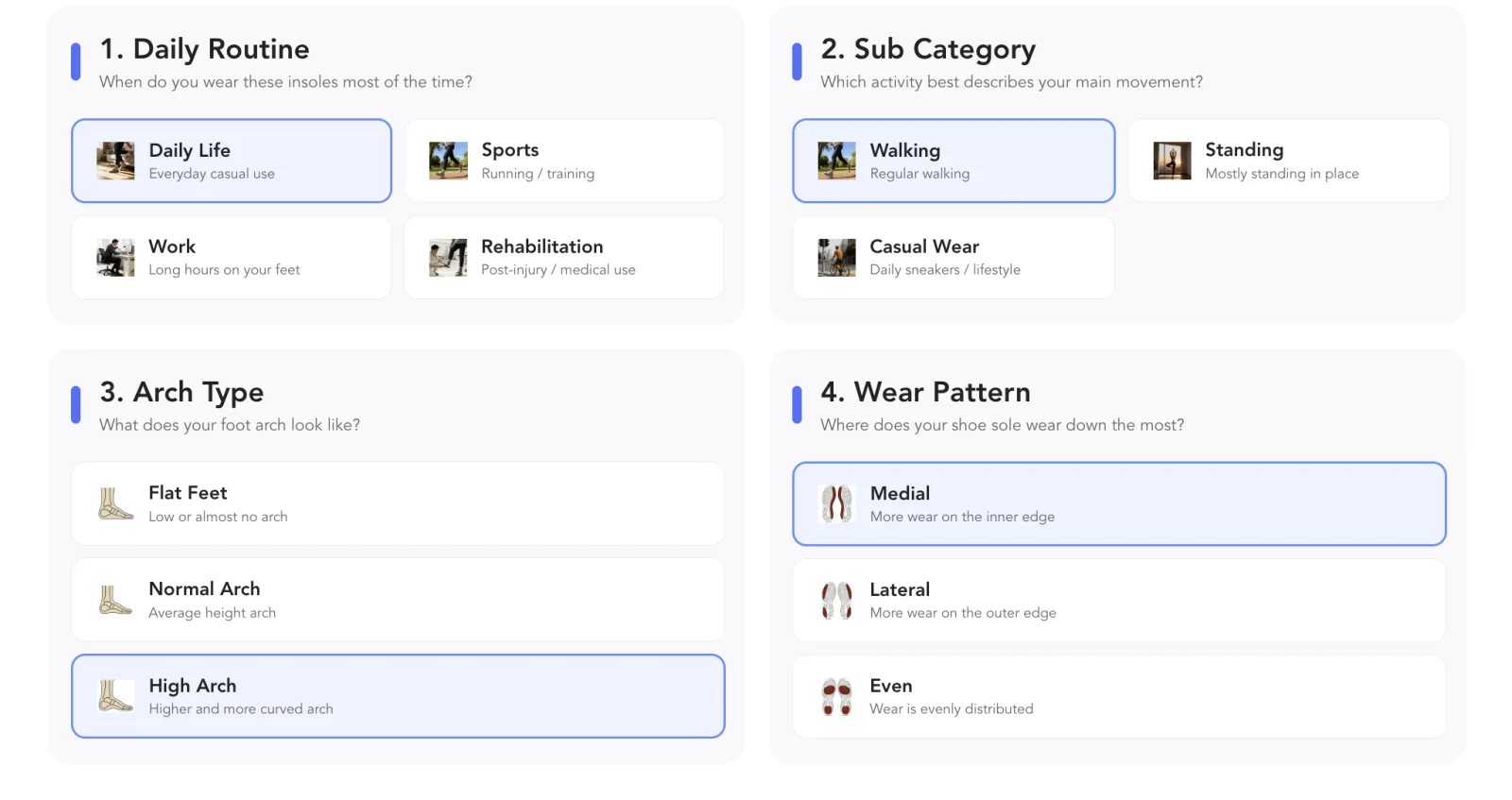
- Answer the guided survey. How high the arch is, any left-right difference, where pressure or discomfort concentrates (heel, ball, outer edge), and your main activity.
- Tune the high-arch parameters. Arch contact height to fill the gap, a deep heel cup, a met pad for forefoot pressure, and cushioned heel and forefoot zones — per foot.
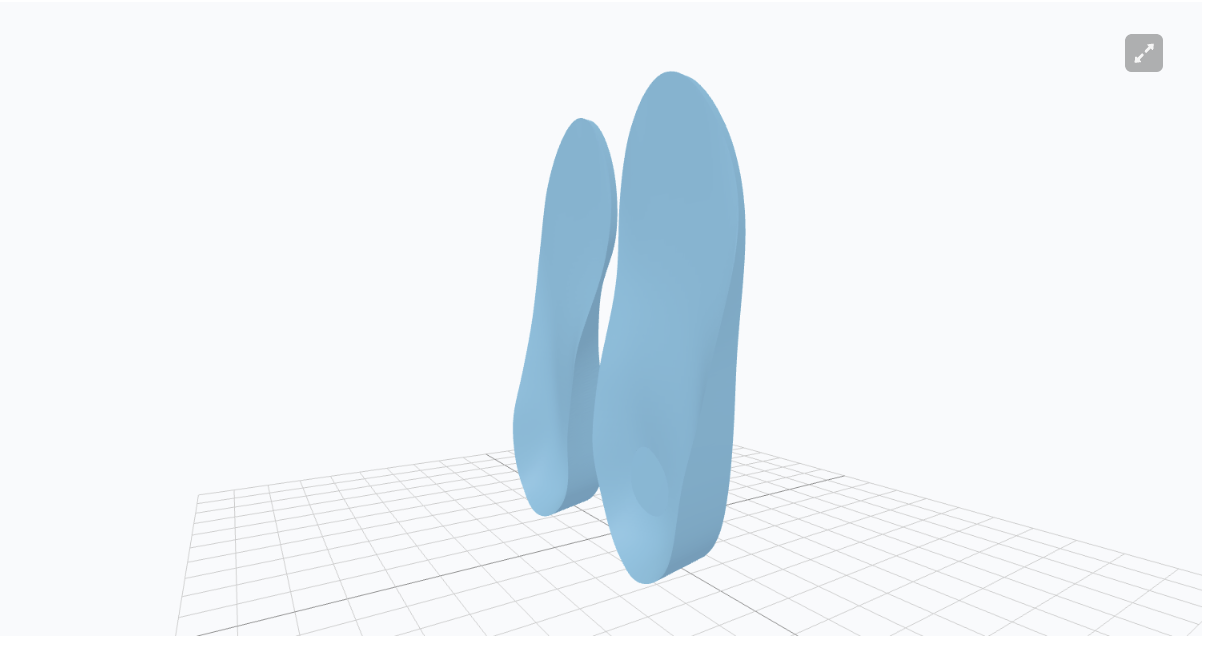
- Export the STL. Ergono3D exports a print-ready file for each foot.
- Print with cushioning in mind. A softer or zoned TPU often suits high arches, where shock absorption matters as much as support; print on any FDM printer that handles flexible filament.
- Wear, then iterate. Adjust arch contact, cushioning, or heel cup and reprint if needed.
The full print walkthrough — slicer settings, TPU handling, and finishing — is in how to make your own custom insoles at home. The same per-foot approach applies to the opposite case in custom insoles for flat feet and to custom arch support insoles.
Answer a short guided survey about your feet. Ergono3D turns it into adjustable parameters — arch contact, heel cup depth, met pad, cushioned zones — per foot, and exports a print-ready STL. Free preview available. For a new or worsening high arch, or any weakness, see a clinician first.
When to see a clinician about high arches.
This is the most important section in this article, and it matters more for high arches than for most foot shapes.
Many high arches are simply an inherited foot shape and usually stay stable. But a high arch can also be a sign of a neurological condition. A cavus foot is often linked to causes such as Charcot-Marie-Tooth disease, cerebral palsy, spina bifida, or stroke, and per Stanford Health Care and Cleveland Clinic, a new or progressive high arch deserves an early look.
Stop and see a clinician — not just swap insoles — if any of these apply:
- A high arch that is new, getting higher, or clearly different between the two feet
- Foot drop, or the foot dragging or slapping when you walk
- Weakness in the foot or ankle, numbness, tingling, or balance problems
- Frequent ankle sprains or a feeling of instability on uneven ground
- A family history of Charcot-Marie-Tooth or other neuromuscular conditions
- A high arch in a child, or one that appears alongside toe deformities like hammertoes or claw toes
Foot drop or muscle weakness in particular is often a neurological sign and should be evaluated promptly — a clinician may refer to a neurologist. None of this means a high arch is usually dangerous; most are not. It means a high arch is worth understanding before treating it as a comfort problem, and an insole is a supportive product, not a diagnosis.
FAQs about custom insoles for high arches.
Can insoles fix or cure high arches?
No. A high arch (pes cavus) is a structural foot shape, often inherited or related to a neurological condition, and an insole does not change it. What an insole can do is fill the gap under the arch for more contact, cushion the heel and ball where pressure concentrates, and stabilize the heel. Insoles support a high-arched foot; they are not a cure, and a new or worsening high arch should be evaluated by a clinician.
What insole features matter most for high arches?
Three things: arch contact that fills the gap under the high arch so the midfoot shares the load, cushioning under the heel and ball where a high-arched foot concentrates pressure, and a deep heel cup to stabilize the heel and limit the outward roll (supination). Unlike a flat foot, the goal is contact and shock absorption with some flexibility — not firm anti-collapse support.
Do high arches and flat feet need opposite insoles?
Largely, yes. A flat foot collapses inward and needs firm medial support that does not give way. A high-arched foot has a rigid midfoot that barely touches the ground, concentrates pressure on the heel and ball, and absorbs shock poorly — so it needs arch contact to fill the gap plus cushioning, rather than firm anti-collapse support. Same design parameters, different settings.
Are high arches a problem for running?
High-arched runners often supinate (roll outward), show lateral shoe wear, and feel impact more because the foot absorbs shock poorly. A supportive, cushioned insole that fills the arch and pads the heel and ball may help some runners manage that load, but individual response varies. Persistent pain, or pain that changes how you run, is a reason to see a clinician rather than to keep swapping insoles.
How does Ergono3D make a custom high-arch insole?
Ergono3D is a custom insole design workflow. The wearer answers guided questions about arch height, use, and where pressure concentrates; Ergono3D turns those into parametric controls — arch contact height, heel cup depth, met pad, cushioned zones, and TPU hardness — set independently per foot, and exports a print-ready STL. The wearer prints, wears, and can return to re-parameterise and reprint.
When should I see a clinician about high arches?
See a clinician if a high arch is new, getting worse, or is clearly higher on one foot, and especially if there is foot drop, weakness, dragging of the foot, numbness, or a family history of conditions like Charcot-Marie-Tooth. A cavus foot is often linked to a neurological cause, so a new or progressive high arch should be checked — early. An insole is a supportive product, not a substitute for that evaluation.
Related: custom insoles for flat feet · custom arch support insoles · why one insole does not fit every activity.