
TL;DR
Generic insoles are designed for an averaged foot — but no average foot exists. Each person's 26 bones, 33 joints, and 100-plus soft-tissue structures combine differently, producing a unique pattern of pressure distribution, arch mechanics, gait, and sensory feedback. When those differ from the template a mass-produced insole assumes, support lands in the wrong places and the benefit drops.
Custom insoles matter because they can be shaped to the individual foot's structure and load rather than a population average. Ergono3D sits on the custom-design side: guided inputs and parametric design generate a printable STL tuned per foot — a design tool, not a diagnosis or treatment, and not a substitute for clinical assessment when symptoms are present.
Key takeaways
- No average foot exists. 26 bones, 33 joints, and 100-plus soft-tissue structures combine uniquely, so an averaged insole shape rarely matches any individual well.
- Pressure distribution is individual. The ideal three-point load triangle breaks with structural deviation; support has to land where each foot actually loads.
- The arch is active, not passive. It stores and releases energy; flat and high arches fail in opposite ways and need opposite support.
- The foot starts the kinetic chain. Abnormal foot motion transmits up through the ankle, knee, and hip, so insole geometry has effects beyond the foot.
- Custom means shaped to the foot, not the average. Ergono3D delivers the custom side via guided inputs → parametric design → printable TPU STL; it is a design tool, not a clinical diagnosis or treatment, and does not replace clinical assessment when symptoms are present.
When we talk about custom insoles, the fundamental question is this: why would anyone actually need them? Is it just marketing hype, or is there a real physiological need? To answer that, we need to look at human body science and understand what makes our feet unique, how modern life challenges them, and why individual differences create real problems. Modern tools now allow custom insole design workflows with STL output, making personalized insoles far more accessible than before.
No two feet are alike.
The human foot contains 26 bones, 33 joints, and over 100 muscles, tendons, and ligaments. These structures combine differently in each person.
Bone length proportions vary. Joint mobility differs. Ligaments have different degrees of tension. Muscle strength and balance aren't the same across individuals. These structural variations lead to functional differences too.
Visible variations
The easiest variation to spot is arch height. Some people have high arches (pes cavus), others have low or flat arches (pes planus), and most fall somewhere in between. Pressure distribution across the foot also varies from person to person, with different patterns of loading in the forefoot, midfoot, and heel, as well as between the inner and outer edges.
Gait pattern differences
When we zoom out to look at the entire lower limb, gait patterns differ too. The angle at which your foot strikes the ground, how much it rotates during walking, the way force is generated during push-off — all of these vary from person to person.
Mass-produced shoes and insoles can't accommodate this individual variation. They're designed for an "average foot," but there's no such thing as a truly average foot. When someone's foot characteristics deviate significantly from this imaginary average, standard insoles simply can't provide appropriate support or pressure distribution.
Addressing uneven pressure distribution.
In an ideal biomechanical model, three contact points form a stable triangle that evenly distributes pressure. Structural deviation breaks that balance.
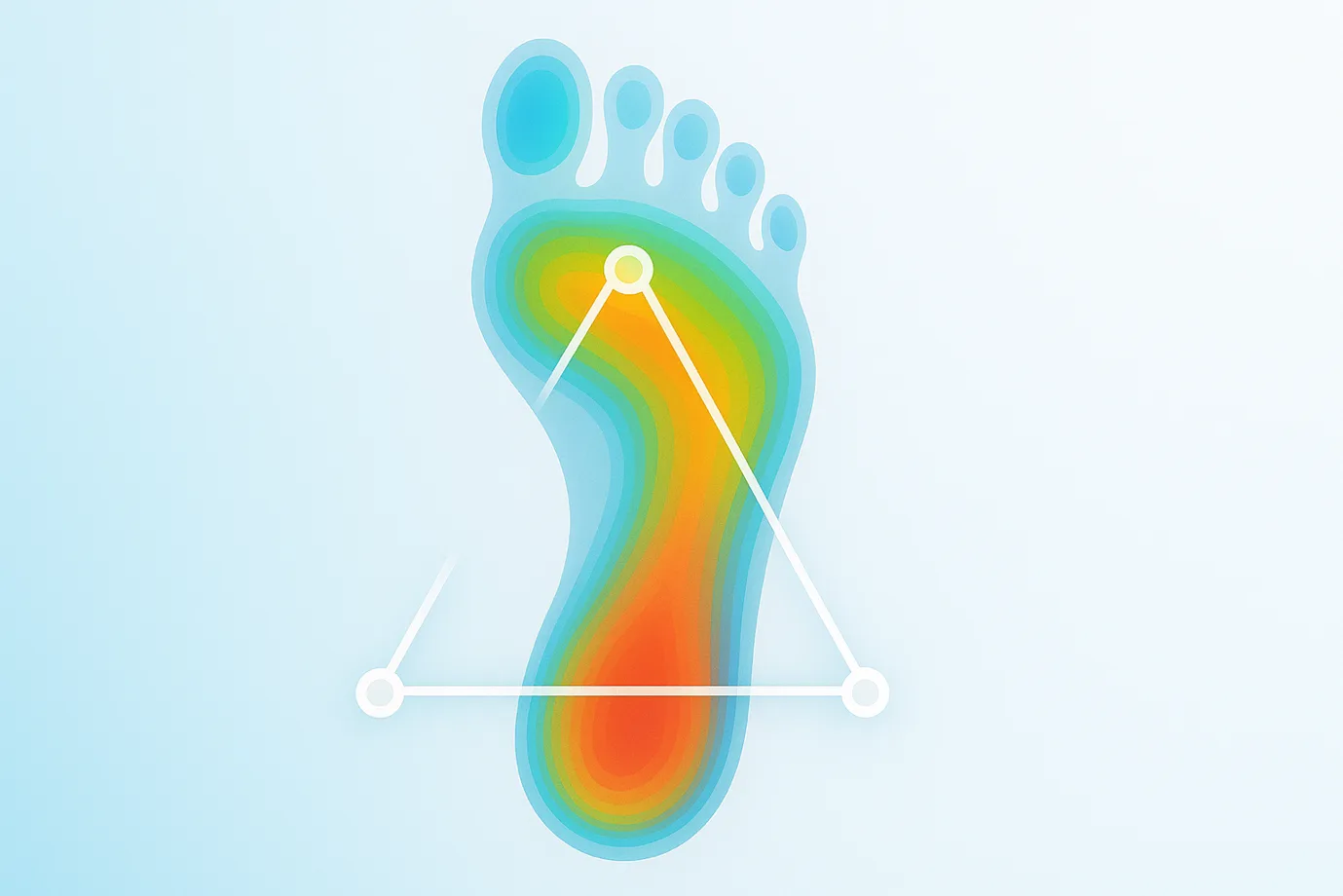
Given individual foot differences, abnormal pressure distribution is a common source of problems. When we stand, the first metatarsal head, fifth metatarsal head, and heel bone form a stable triangle that evenly distributes pressure. During walking, pressure smoothly transfers from the heel to the outer foot, then to the forefoot in a fluid rolling pattern. But when foot structure deviates from this ideal, some areas bear too much load while others bear too little.
The consequences of excessive pressure
Excessive local pressure leads to several issues:
- Direct pain: Areas under the most stress become painful
- Skin changes: Concentrated pressure causes skin thickening, forming calluses or corns
- Medical complications: for people with diabetes, abnormal pressure can contribute to ulcers — a medical issue that should be managed by a clinician
- Upward transmission: Abnormal foot pressure affects the ankle, knee, and hip joints, altering the entire lower limb's mechanical structure
How pressure mapping works
Clinicians use pressure mapping to see which areas bear too much pressure and which lack adequate support. A custom insole applies the same principle: place softer, higher-contact material in high-pressure zones to spread force, add firmer support where it's needed, and smooth the transitions between them so load is distributed more evenly rather than concentrated. Ergono3D brings this within reach through parametric insole design — you set arch, heel-cup, and firmness from a guided survey (no pressure plate or scan required), not from a clinical measurement.
Supporting arch function.
The human arch isn't just a passive support structure — it stores and releases energy during movement. Dysfunction in either direction creates distinct biomechanical problems.
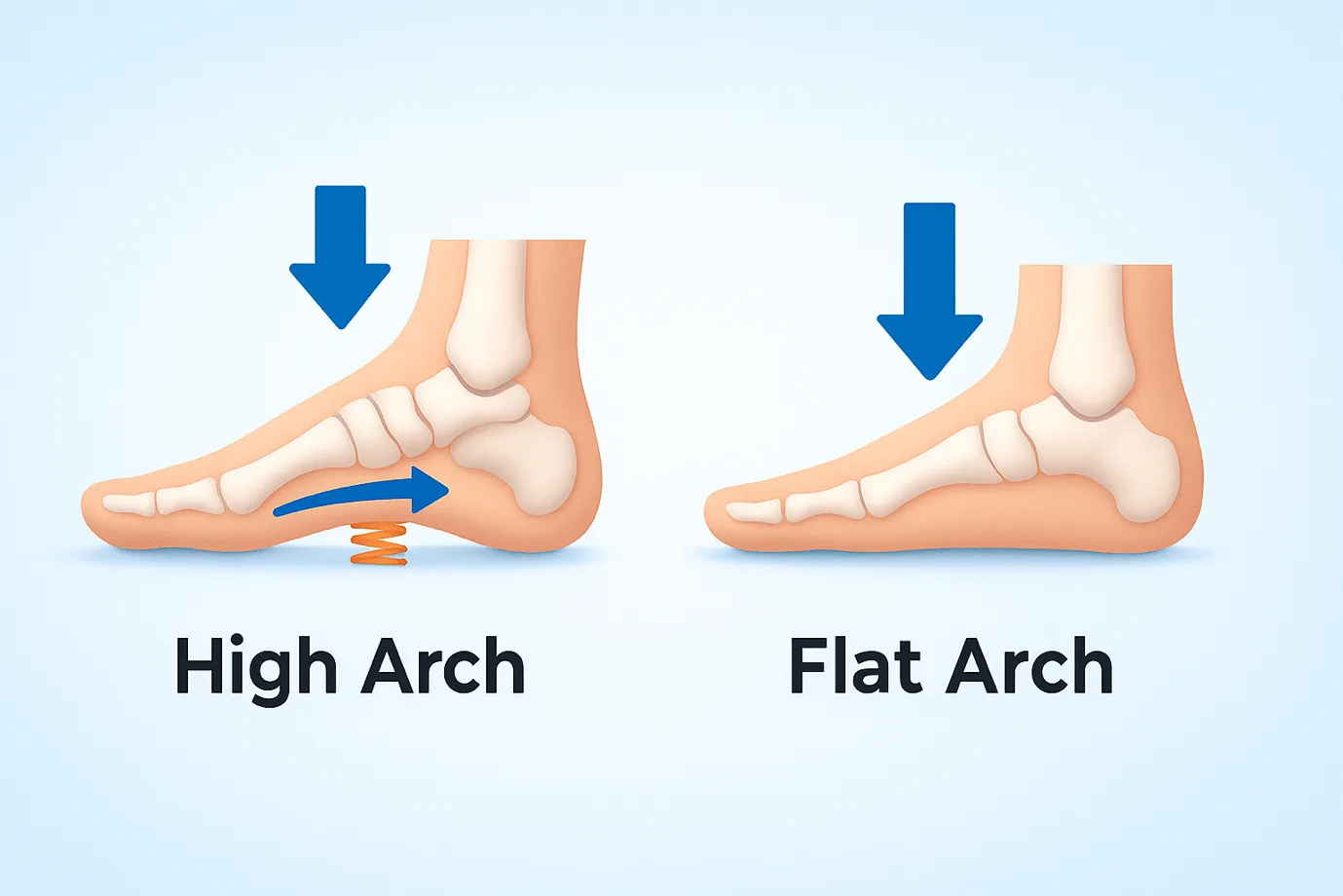
From a structural mechanics perspective, an arch is an efficient load-bearing structure — it converts vertical pressure into compressive stress along the arch line, distributing loads throughout the structure. When we walk, the arch lowers slightly under load, storing elastic energy like compressing a spring, then rebounds during push-off to release stored energy and assist forefoot propulsion.
Problems with flat feet
People with flat feet (lowered or absent arches) lose the mechanical advantage of the arch structure. Vertical pressure can't be effectively distributed, abnormal tensile stress develops in soft tissues — particularly the plantar fascia and Achilles tendon — and the energy storage and release function is impaired, potentially increasing muscular effort during walking.
Problems with high arches
People with high arches (abnormally elevated arches) face different issues. Increased foot rigidity reduces adaptation to ground surfaces, decreased shock absorption transmits more impact force to heel and forefoot, and minimal midfoot contact concentrates pressure in just those two areas.
Custom solutions for arch problems
For people with arch dysfunction, custom insoles provide external structural support and functional compensation: support structures in the medial arch area hold up collapsed arches from below, midfoot filling increases contact area for more uniform pressure distribution, and geometric restoration partially restores the arch's mechanical function.
Influencing movement patterns.
The foot is the starting point of the kinetic chain. Abnormal foot movement transmits up through the ankle, knee, and hip — causing problems well beyond the foot itself.
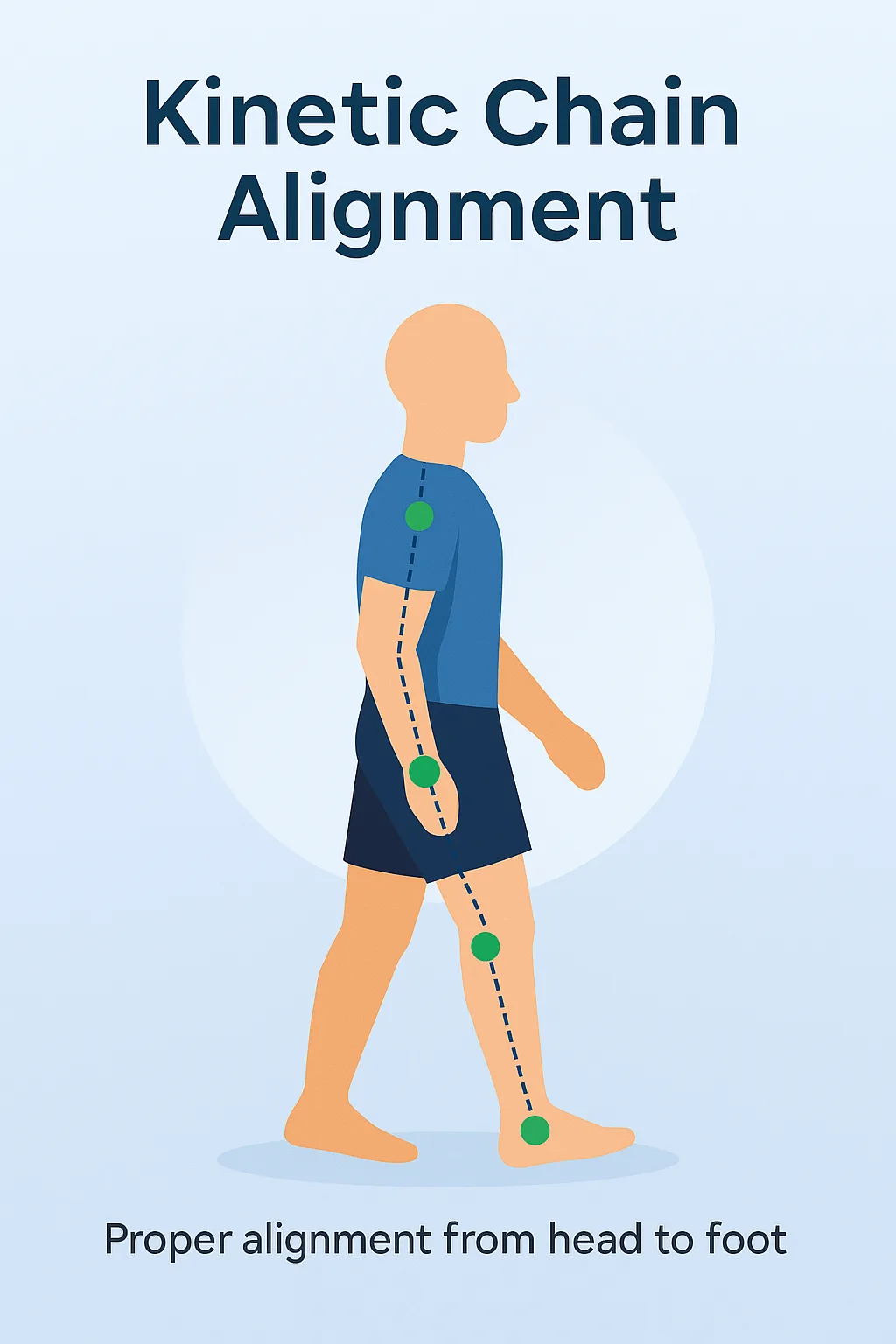
Human walking is a complex motor process involving the entire kinetic chain from foot to torso. The foot pronates moderately after landing to help absorb shock, supinates during stance phase to provide stability, and moves to assist push-off during propulsion. These movements are physiological within normal ranges, but become problematic when they exceed normal limits.
Excessive pronation
When the foot rotates too far inward after landing, the motion transmits up the kinetic chain. The tibia follows into internal rotation, and the knee's movement path changes, potentially developing a valgus tendency. This has been associated with some knee discomforts, though the relationship varies between individuals and is not fully settled in the research.
Rigid supination
Some people's feet lack normal pronation buffering, remaining rigid at landing. This means insufficient shock absorption and more impact force transmitted directly to lower limb joints — increasing the risk of stress-related injuries. Every foot contact generates impact force ranging from 1–1.5× body weight during walking to 2–3× during jogging, with higher multiples during running and jumping.
Custom insole interventions
Custom insoles provide intervention at the kinetic chain's starting point. Wedge structures in the rear foot area alter initial joint angles — medial wedges limit excessive pronation, while lateral wedges promote mobility in rigid feet. Biomechanical research suggests these designs can influence kinematic parameters and ground reaction forces along the kinetic chain, though the size of the effect varies by person and study.
Optimizing sensory feedback and balance.
The skin on the sole of the foot is densely packed with mechanoreceptors — and the quality of information they send to the brain directly affects balance and motor control.
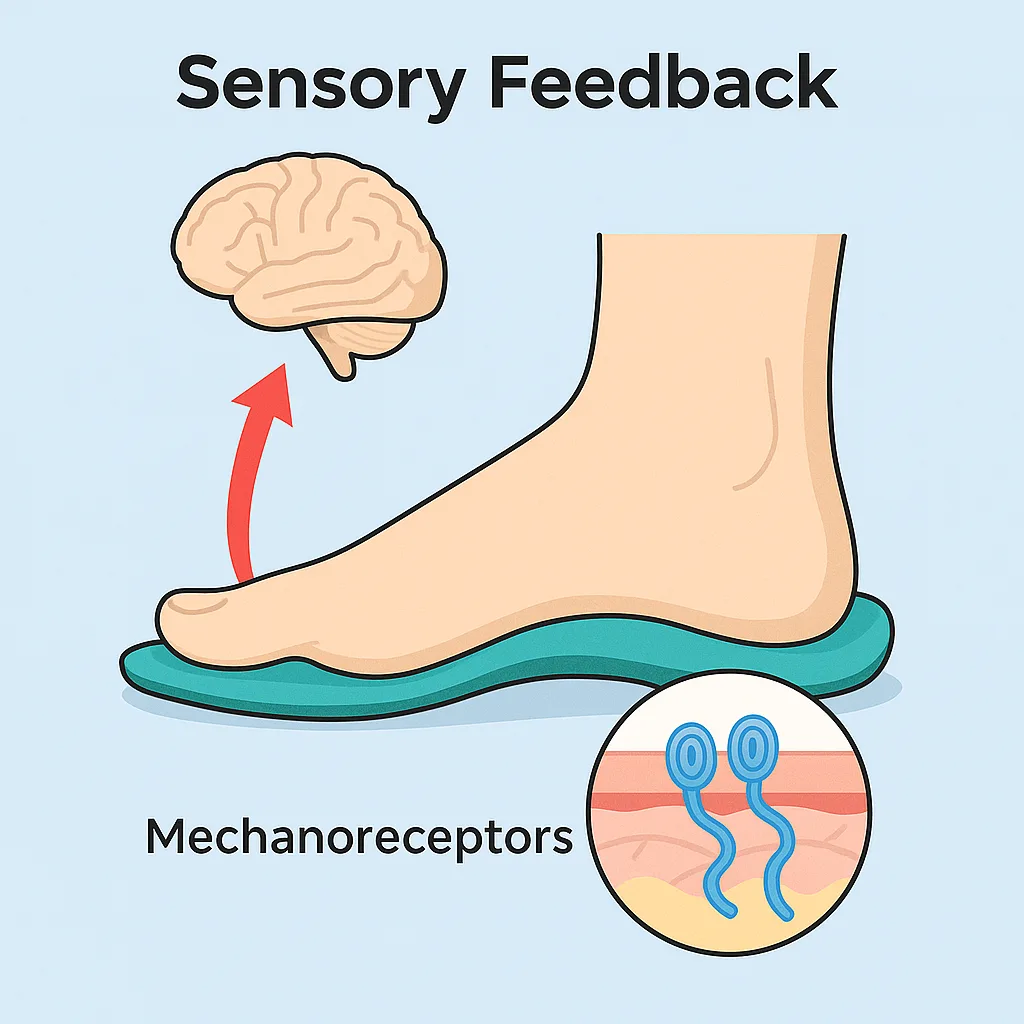
The mechanoreceptors in the plantar skin are sensitive to pressure, touch, and vibration, and they're a crucial part of the body's proprioceptive system. This sensory information is critical for standing balance, real-time walking adjustments, and appropriate muscle activation strategies during movement.
Modern life has changed the sensory environment significantly: walking on flat, hard surfaces alters stimulus patterns; thick-soled shoes with soft padding reduce sensory input; and structural abnormalities cause abnormal pressure distribution, meaning receptors receive skewed information that can affect motor control strategies.
For people with abnormal sensory feedback or reduced balance control, custom insoles serve as a tool for adjusting the sensory interface. Selective pressure modulation can increase or decrease stimulation in specific zones, helping the nervous system obtain clearer, more balanced feedback.
Who actually needs custom insoles?
Not everyone needs custom insoles. For people whose foot structure is close to the "average model," who have no obvious symptoms, and whose feet function normally, standard insoles are sufficient.
The underlying point is straightforward: individual variation in foot structure and function creates real biomechanical differences that generic, one-size-fits-most products are not designed to address. Custom insoles are a targeted, evidence-informed approach to supporting foot function based on individual needs rather than categorical approximations — though, as with most orthotic interventions, individual response varies.
Common questions about why custom insoles matter.
Why can't mass-produced insoles accommodate individual feet?
Mass-produced shoes and insoles are designed for an "average foot," but there's no such thing as a truly average foot. When someone's foot characteristics deviate significantly from this imaginary average, standard insoles simply can't provide appropriate support or pressure distribution.
How do custom insoles address uneven pressure distribution?
Clinicians use pressure mapping to see which areas bear too much pressure and which lack support. A custom insole applies the same principle — softer, higher-contact material in high-pressure zones, firmer support where it's needed, and smooth transitions between them — to bring distribution closer to an even, comfortable baseline.
How do flat feet and high arches differ as biomechanical problems?
People with flat feet lose the mechanical advantage of the arch structure, so vertical pressure can't be effectively distributed and energy storage is impaired. People with high arches face the opposite issue: increased foot rigidity reduces adaptation to surfaces, decreased shock absorption transmits more impact to the heel and forefoot, and minimal midfoot contact concentrates pressure in those two areas.
Does everyone need custom insoles?
Not everyone needs custom insoles. For people whose foot structure is close to the "average model," who have no obvious symptoms, and whose feet function normally, standard insoles are sufficient. But for those with significant structural abnormalities, obvious related symptoms, or special functional needs, custom insoles are functional solutions designed to address real problems.
Design custom insoles based on your guided answers. Free preview — 5 credits, no card required. Export the STL when you're ready to print.