
TL;DR
Soccer cleats sit low to the ground with thin soles and studs you can feel through a long match — there's very little built-in cushioning. The best insoles for soccer cleats have to be low-volume to fit the tight boot, with arch support and a deep heel cup to lock the foot for sprints and cuts, plus enough cushioning to take the edge off the studs — firm and durable, not soft foam that bottoms out. A custom 3D-printed soccer cleat insert tunes the arch, heel cup, and cushioning per foot, stays thin enough for cleats, and can be reprinted from the same design. Insoles can improve comfort, fit, and support; they don't guarantee faster play or stop injuries, and pain that persists belongs with a clinician.
Key takeaways
- Soccer cleats = thin + studded + low-volume → little cushioning, studs felt underfoot; the insole must stay thin to fit.
- Soccer load = sprinting + cutting + accel/decel on turf — so a locked heel and arch support matter alongside cushioning.
- The best insoles for soccer cleats: low-volume, arch support, deep heel cup, stud-offset cushioning, durable — firm, not soft-collapsing.
- Custom levers: arch height/firmness, deep heel cup, cushioned heel/forefoot zones, firm TPU, thin profile — per foot.
- Ergono3D = parametric, per-foot, iterable STL: you pay for the design with credits (see pricing) and print it yourself (filament, printer, and time). Comfort/fit/support — not a performance or injury-prevention promise; persistent pain → clinician.
Searches for insoles for soccer cleats and the best insoles for soccer cleats usually come from players whose feet ache after a match, who feel the studs through a thin sole, or who find the stock insole gives them nothing. Soccer is demanding on the foot in a way that is specific to cleats: the boot is thin, snug, and studded, and the game is sprinting and cutting on turf. The soccer cleat insert that suits it looks different from a cushy running insole — and, above all, it has to be thin enough to fit. This guide covers what soccer does to the foot, what the best insoles for soccer cleats need, and where a durable, low-volume custom 3D-printed insert fits — including an honest look at the "play faster" and "injury-proof your feet" claims. It applies whatever you call the game: soccer cleats and football boots are the same thin, studded, low-volume boot, and American football cleats share the recipe too.
What soccer does to the foot.
The defining fact: soccer is played in a thin, studded, low-volume cleat. The foot sits close to the ground, sprints and cuts, and feels the studs from below.
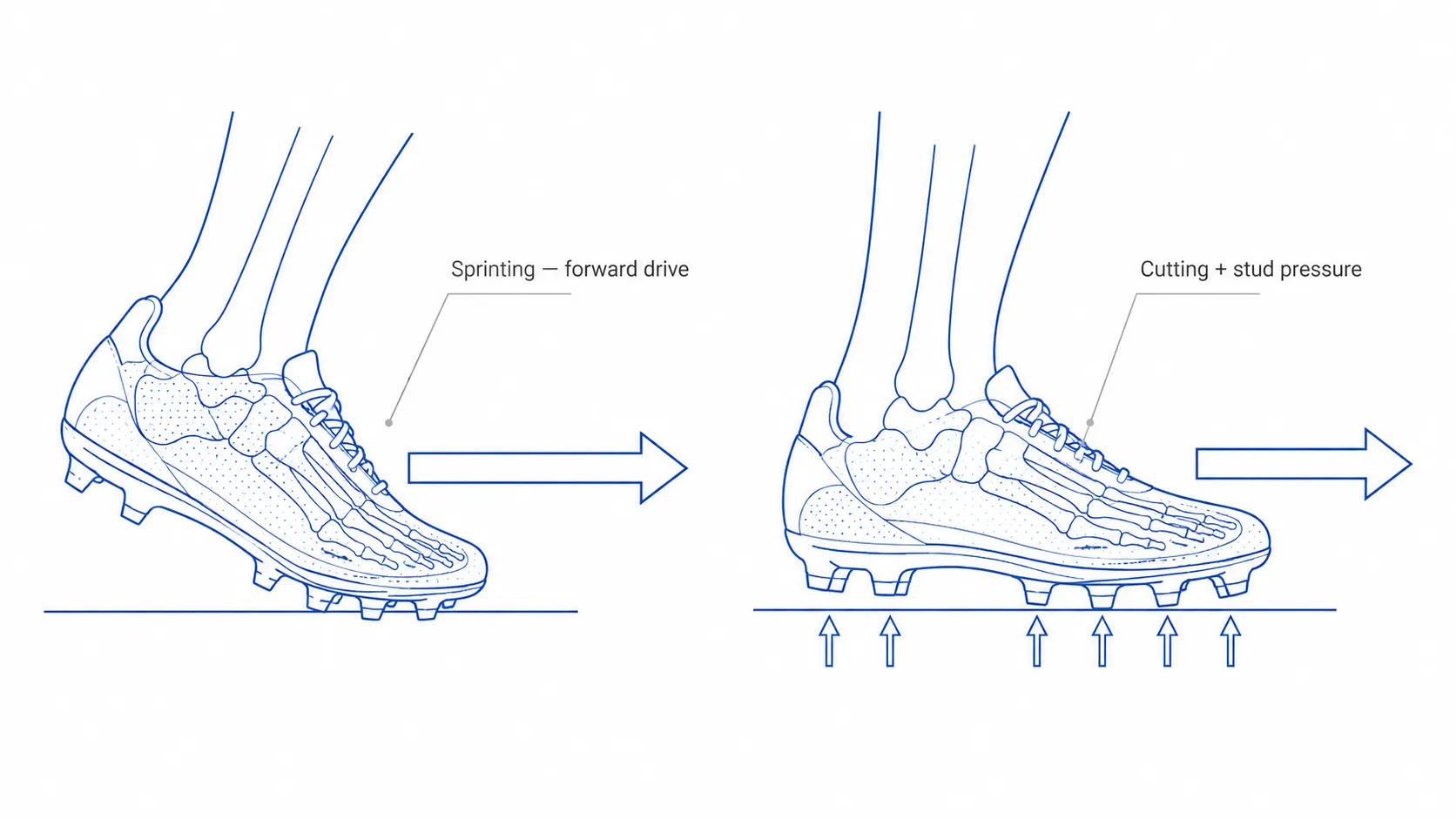
Thin, studded boots. Cleats are built to be light and close to the ground, which means a thin sole and very little built-in cushioning. The studs that grip the turf also transmit pressure straight up into the foot, so over ninety minutes — or four quarters — you can end up feeling the studs underfoot, especially on firm ground. There is simply not much material between your foot and the field.
Sprinting and acceleration. Soccer is repeated bursts: accelerating, decelerating, and sprinting in a straight line. Each drive loads the forefoot and pushes the foot forward in the boot. A footbed that supports the arch and locks the heel helps the whole foot transfer that drive under control instead of sliding around inside a snug boot.
Cutting and changing direction. The other half of the game is lateral: planting and cutting, sidestepping, turning. On a hard cut, force goes through the foot sideways, and the arch and ankle take stress they never see standing still. A foot that slides or rolls inside the boot is both slower and more vulnerable, so a locked heel and arch support are a real priority.
The low-volume constraint. Here is what makes football unusual: the boot is deliberately tight and low-volume for a close, responsive feel. That means an insole cannot just be thick and plush — if it raises your foot too much, the boot will not fit or will feel cramped, and you lose the snug control cleats are designed for. Whatever support and cushioning a football insole adds, it has to do it in a thin profile.
Put together, soccer asks for a footbed that is thin, supportive, and firm — one that locks the foot for sprints and cuts and takes the edge off the studs, without adding bulk the boot cannot accommodate. That combination of "supportive but low-volume" drives the whole design.
What the best insoles for soccer cleats actually need.
Map those loads to design and the priorities are clear — thin first, then supportive and firm.
A soccer cleat insole that holds up tends to combine:
- A low-volume profile — thin enough to fit inside a tight, snug cleat without crowding the boot or lifting the foot too high.
- Arch support — to replace the minimal support a thin boot provides and to hold the arch through sprints and cuts.
- A deep heel cup — to lock the heel for acceleration, deceleration, and hard direction changes.
- Stud-offset cushioning — targeted padding at the heel and forefoot to take the edge off the studs you feel through a thin sole.
- A firm, durable build — football rewards a footbed that holds its shape on turf under repeated load, not soft foam that bottoms out by the second half.
The trade-off worth naming: a thick, plush insole feels good in your hand but will not fit a cleat, and very soft foam offers little control when you plant and cut. For soccer, a thin, firm footbed with targeted cushioning beats all-over softness. As cleat-insole brands such as CURREX and Tread Labs describe it, the goal is arch support and a deep heel cup with enough cushioning to handle the studs, all in a profile slim enough for the boot — support and fit, not bulk.
The custom design levers for soccer cleats.
A custom soccer insole is custom because these are tuned to your foot and your boot, not picked from a size bucket.
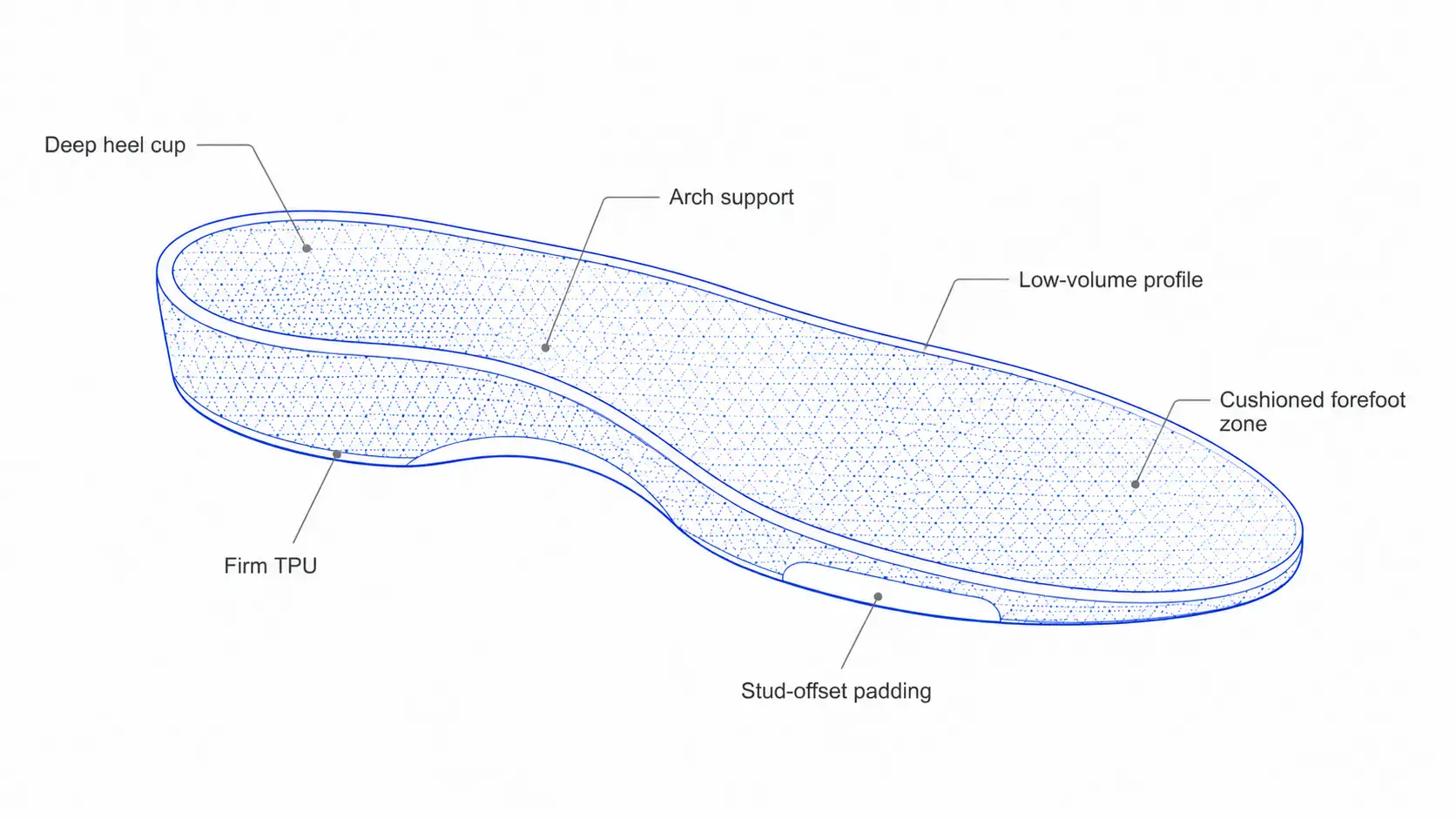
Ergono3D is a guided, parametric 3D printed custom insole design platform. For soccer cleats, the levers that matter are:
- Overall profile and thickness — kept low-volume so the insole fits the tight cleat; the height is a parameter you can dial down for a snug boot.
- Arch height and firmness — set to your foot type so the arch is supported through sprints and cuts without sitting too proud in a thin boot.
- Heel cup depth — deeper to lock the heel for acceleration, deceleration, and lateral cuts.
- Cushioned, stud-offset zones — padding placed at the heel and forefoot to blunt the studs where you feel them most, without thickening the whole insole.
- Firm, durable TPU — a firmer durometer so the footbed supports under load and survives turf and a season of play.
Every control is set independently per foot, and the output is a print-ready STL. For how each parameter behaves, see understanding insole design parameters. The iteration angle applies here too: dial in the profile, arch, and heel cup, play on it, then adjust the design or reprint the same one.
By foot type — and both kinds of football.
The soccer-cleat setup still starts from your foot type, and the same recipe carries across cleated field sports.
Underneath the soccer-specific needs is foot type. A flat, overpronating player needs firm medial support and a deep heel cup so the arch does not collapse on hard cuts — all kept low-volume so it still fits the boot — see custom insoles for flat feet. A high-arched player needs the arch gap filled plus stud-offset cushioning, because a rigid high foot sits hard against a thin sole and feels the studs more — see custom insoles for high arches. The pillar piece, why one insole design does not fit every activity, makes the general case: match the foot first, then the sport.
The same recipe carries to both senses of football. Soccer cleats (or football boots, if you prefer) and American football cleats are both thin, studded, low-volume boots played on turf or grass, with the same mix of sprinting and cutting and the same studs felt underfoot — so both want a low-volume profile, arch support, a deep heel cup, and stud-offset cushioning. What changes is the degree: a winger or receiver sprints and cuts more and wants the heel truly locked, while a lineman absorbs heavier static load and may want more cushioning, and the parameters shift to match. So whether you searched for insoles for soccer cleats or insoles for football cleats, the recipe here applies — and the same priorities extend to other cleated field sports like rugby and lacrosse.
Pre-made versus custom for soccer cleats.
Pre-made soccer cleat inserts are good and enough for many players. The custom case is exact fit, a tuned low profile, and reprinting from the same design.
| Option | What you pay | Per-foot tuning | Replace when worn | Best fit for players |
|---|---|---|---|---|
| Stock cleat insole | Included | No | Wears fast | Casual play — upgrade for regular matches |
| Pre-made soccer cleat insert (CURREX, Tread Labs, SOLE) | Brand retail price | No (arch bucket) | Buy another | Many players; neutral feet; first upgrade |
| Low-volume support insole | Brand retail price | Limited (size/volume tiers) | Buy another | Players who need thin support that fits a snug boot |
| Ergono3D custom 3D printed insole | Design credits + your print* | Yes (per foot, parametric) | Reprint from the same design | Off-bucket arches, asymmetry, tuning a thin profile, reprinting when worn |
*The design is paid for with Ergono3D credits (see current pricing); an STL you have already paid for can be downloaded again at no charge. The print is on you: TPU filament (estimate it from your slicer's weight estimate and your filament price), printer, failed prints, electricity, top cover, and your time. Brand insole prices vary by country and store. Ergono3D is a parametric TPU footbed you tune and print — a different product, with a different goal, from an off-the-shelf soccer cleat insert.
For players, the custom argument is exact fit per foot, a profile you can tune thin enough for your specific boot, and reprinting the same design when a pair wears down over a season — or adjusting a parameter first. For the general worth-it case, see are custom insoles worth it?
How to 3D print an insole for soccer cleats.
Same loop as any Ergono3D insole, with soccer's emphasis on keeping it thin enough for the cleat and firm enough for turf.
- Answer the guided survey. Foot type and arch height, any left-right difference, your sport and position, how much you sprint and cut, and where the studs or soreness show up.
- Tune the soccer parameters. A low-volume profile, arch support, a deep heel cup, stud-offset cushioning at the heel and forefoot, and a firm durable structure — per foot.
- Export the STL. Ergono3D exports a print-ready file for each foot.
- Print thin and firm. Use a firm TPU and a low profile so the insole fits the tight cleat and holds shape under sprints and cuts; print on any FDM printer that handles flexible filament. If the boot is very snug, remove its stock insole before fitting.
- Play, then iterate. Adjust the profile, arch, heel cup, or cushioning and reprint when a pair wears down.
The full print walkthrough — slicer settings, TPU handling, finishing — is in how to make your own custom insoles at home. The same per-foot approach applies to other activities, including insoles for basketball and insoles for running.
Answer a short guided survey about your feet and how you play. Ergono3D turns it into adjustable parameters — low-volume profile, arch support, deep heel cup, stud-offset cushioning — per foot, and exports a print-ready STL for your soccer cleat insert. Free preview available. For an injury or persistent pain, see a clinician.
Comfort, soreness, and injury.
Soccer cleat insoles attract two big marketing claims. Both deserve a careful answer.
"Play faster, with more burst." Some insoles are marketed around added speed and explosiveness off the mark. Be skeptical of that framing. A supportive, low-volume TPU footbed like the ones Ergono3D designs is about comfort, fit, and support — a foot that feels locked-in and a sole that takes the edge off the studs — not adding a yard of pace. We do not claim it makes you faster, because that is not what a custom footbed is for.
"Injury-proofs your feet." Insoles are often pitched as protection against the injuries common in cleated sports. The honest position: a low-volume insole with arch support and a deep heel cup may improve how comfortable, fitted, and supported the foot feels over a long match, which is worthwhile — but no insole reliably stops injuries, and the systematic evidence for footwear and inserts as sports-injury prevention is limited. Treat an insole as a comfort, fit, and support upgrade, not an injury shield.
On soreness specifically: aching, tired feet after a match on firm turf are common, and a big part of that is the thin sole and the studs underfoot. A soccer cleat insole that adds stud-offset cushioning and supports the arch can genuinely make a long match more comfortable — that is a real, reasonable benefit, and a fair reason to use one.
The practical takeaway: a good soccer cleat insole can make the foot feel supported, fitted, and a little better cushioned against the studs, and that is a real benefit. It is not a speed device or an injury-prevention guarantee, and it is no substitute for conditioning, the right boots for the surface, and sensible load. Treat pain as information — a foot that keeps hurting, a sharp or localized pain, or soreness that persists or worsens should be assessed by a clinician or podiatrist, not managed with another insole.
FAQs about insoles for soccer cleats.
What are the best insoles for soccer cleats?
The best insoles for soccer cleats are not the plushest — they are the ones that stay low-volume enough to fit the thin, snug boot while still adding arch support, a deep heel cup, and stud-offset cushioning. Pre-made cleat inserts from CURREX, Tread Labs, or SOLE suit many neutral feet and sell at each brand's retail price. The case for a custom soccer cleat insert is an exact, per-foot fit, a profile you can tune thin enough for your specific cleat, and reprinting from the same design when a pair wears down over a season. The right footbed is whatever fits your foot and your boot — match the foot type first, then the cleat.
Do insoles help in soccer cleats?
For many players, yes — a good soccer cleat insole adds a deep heel cup that locks the foot for sprints and cuts, arch support the thin cleat does not provide, and a layer of cushioning that takes the edge off the studs you feel underfoot, which can improve comfort, fit, and support over a long match. What an insole cannot guarantee is faster play or freedom from injury. Treat it as a comfort, fit, and support upgrade, not a performance or injury fix — and it only helps if it stays thin enough to fit the boot.
What makes a good soccer cleat insole?
Five things: a low-volume profile so it actually fits the tight soccer cleat, arch support to replace the minimal support built into a thin boot, a deep heel cup to lock the foot for sprints and cuts, stud-offset cushioning at the heel and forefoot to take the edge off the studs, and a firm, durable build that survives turf and does not collapse into soft foam. Soccer rewards a thin, supportive, firm footbed over plush softness that would not fit the cleat anyway.
Will insoles fit in tight soccer cleats?
Only if they are low-volume. Cleats are deliberately thin and snug, so a thick aftermarket insole often will not fit or makes the boot feel cramped. The fix is a low-volume insole built for cleats, or removing the stock insole before fitting one. A custom 3D-printed insole has an advantage here: the profile is a parameter, so it can be tuned thin enough to fit your specific boot while still carrying arch support and a heel cup.
Do soccer cleat insoles guard against injuries or help you play faster?
Be skeptical of both claims. Some insoles are marketed around faster, sharper play, and others around warding off injuries, but neither is something an insole can reliably guarantee. A low-volume insole with arch support and a deep heel cup may improve how comfortable, fitted, and supported the foot feels, which some players find helps over a long match — but it is not a speed device or an injury-prevention guarantee, and the evidence for inserts as sports-injury prevention is limited. An actual injury, or pain that persists, should be assessed by a clinician.
Soccer and American football — same insole needs?
Largely yes. Both are cleated field sports played on turf or grass in thin, studded, low-volume boots, with a lot of sprinting and cutting and studs felt underfoot. So both want the same core: a low-volume profile, arch support, a deep heel cup, stud-offset cushioning, and a firm durable build. The difference is degree — a receiver or winger sprints and cuts more, a lineman absorbs heavier static load — and the parameters shift to match rather than the basic recipe changing.
How does Ergono3D make a custom soccer cleat insole?
Ergono3D is a custom insole design workflow. The player answers guided questions about foot type, arch height, sport and position, and how much they sprint and cut; Ergono3D turns those into parametric controls — a low-volume profile, arch support, a deep heel cup, cushioned stud-offset zones, and a firm durable structure — set per foot, and exports a print-ready STL. The player prints the soccer cleat insert thin and firm, plays on it, and can return to re-parameterise and reprint.
Related: insoles for basketball · insoles for running · why one insole does not fit every activity.