TL;DR
A ski boot footbed is not there for cushioning — the rigid shell already protects the foot. Its job is to support the arch, stabilize the heel, and spread pressure evenly so the foot stays centered and power transfers cleanly from edge to edge. Stock footbeds barely do this. A custom footbed tunes arch height, heel cup depth, a low-volume thickness for the tight boot, and a firm TPU — per foot. Ergono3D generates that as a per-foot, iterable, print-ready STL: you pay for the design with credits and print it yourself, instead of paying a shop for a molded footbed. Not every skier needs custom, and a bootfitter still owns shell work and complex fits.
Key takeaways
- In a ski boot, "footbed" and "insole" mean the same thing — the supportive layer under the foot. The real question is stock versus custom.
- A ski footbed's job is support, stability, and even pressure → centering and edge control, not cushioning.
- Custom tunes arch height, heel cup depth, low-volume thickness, posting, and firm TPU per foot — stock footbeds are minimal and generic.
- Ergono3D = parametric, per-foot, iterable STL: you pay for the design with credits (see pricing) and print it yourself (filament, printer, and time).
- Quality matters: a poorly shaped footbed can hurt. Iteration — reprint after a ski day — fixes the shape. A bootfitter still owns shell molding, canting, and complex or painful fits.
Demand for custom footbeds for ski boots has a simple explanation: most skiers eventually learn that the footbed their boots shipped with is doing almost nothing. Boot manufacturers put very little into stock footbeds because they assume you will replace them. The question is what to replace them with — a cheap drop-in, a molded footbed from a bootfitter, or a custom-designed footbed you print yourself — and what actually needs to be customized to make a difference.
What a ski boot footbed actually does.
Start with the mechanics, because they are different from a running shoe. A ski boot is a rigid shell, so the footbed's job is not to absorb impact — it is to position and stabilize the foot.
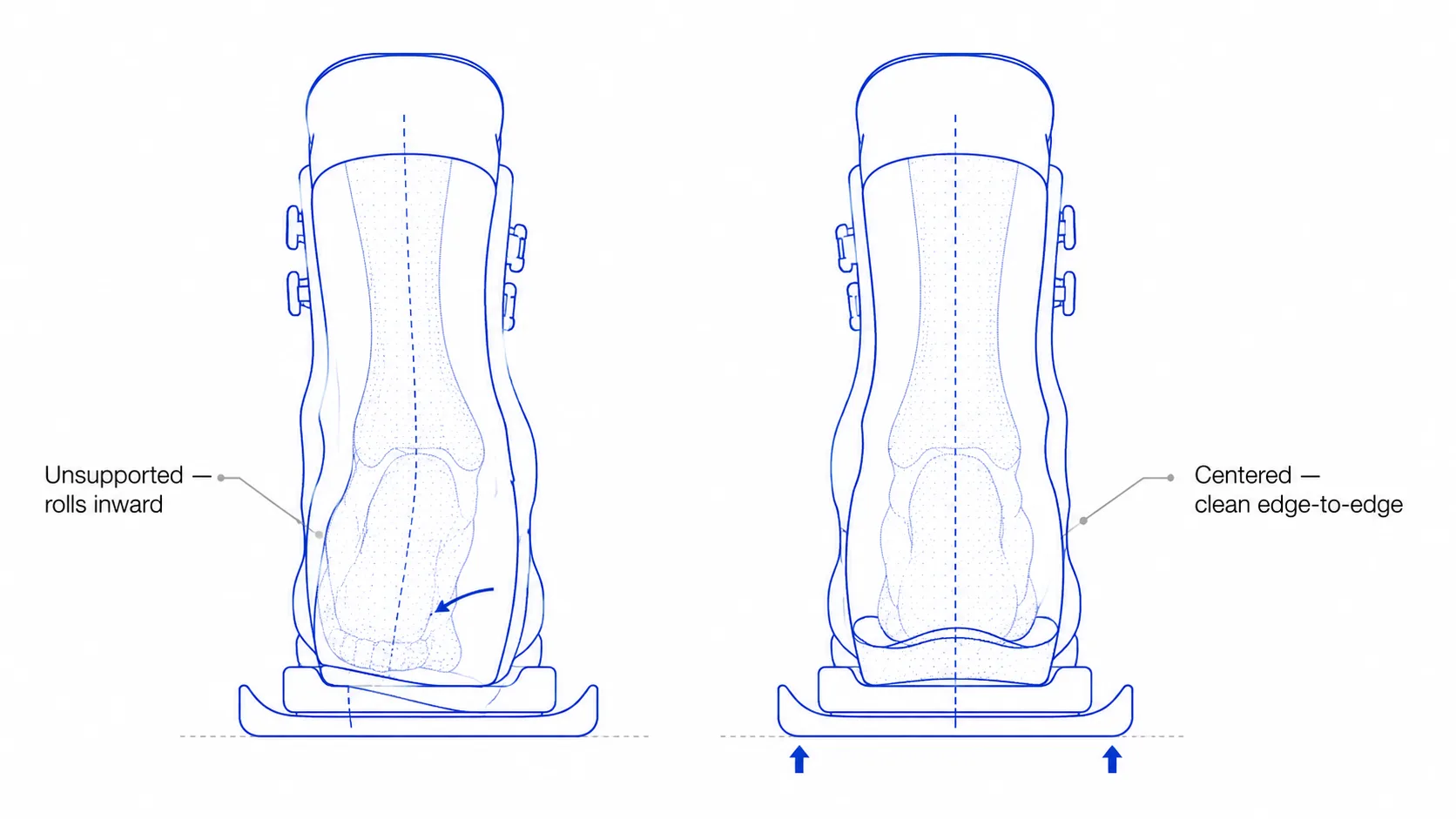
In a soft running shoe, an insole cushions repetitive impact. A ski boot is the opposite environment: a stiff plastic shell already protects the foot, and there is very little spare space inside. So a ski footbed earns its place a different way — by supporting the arch, stabilizing the heel, and distributing pressure evenly across the whole foot rather than letting it load up under the heel and ball.
Those three things add up to one outcome that skiers feel directly: the foot stays centered. A well-supported foot does not collapse inward (pronate) and slide off its natural position, so weight stays balanced and it is easier to move from edge to edge with consistent pressure through the turn. Editorial guides like evo's footbed guide describe the same chain: support the heel and arch, control the inward roll, keep the foot centered, improve edge-to-edge response.
The common complaints a supportive footbed can help with — arch fatigue, burning under the ball of the foot, slow or vague turn response, and trouble holding an edge — are mostly symptoms of a foot that is unsupported and moving around inside the shell. None of this is about cushioning. It is about holding the foot still in the right shape.
Footbed or insole, and stock versus custom.
Two pieces of vocabulary cause confusion. "Footbed" and "insole" are the same thing in skiing. The decision that actually matters is stock versus custom.
In the ski world footbed and insole are used interchangeably — both mean the supportive layer beneath your foot inside the boot. "Footbed" is just the more common term on the hill. So the choice is not footbed versus insole; it is whether that layer is generic or shaped to your foot.
Stock footbeds are the thin inserts that come in new boots. Very few offer more than token support, and none are fitted to your foot — manufacturers assume you will swap them out. They are the right thing to replace first.
Off-the-shelf and cut-to-fit footbeds (Sidas, Superfeet, SOLE and similar) are a real upgrade and, for many skiers, enough. They add genuine arch support and a firmer heel cup. Like any template, though, they come in a few arch buckets and the same shape goes in both boots.
Custom footbeds are shaped to one specific foot. Historically that meant a molded footbed made in a shop. It also includes a parametric workflow like Ergono3D, where the geometry is generated per foot and printed. An honest caveat from the ski world applies here: custom only helps if it is well made. Bootfitters report that many custom footbeds arriving from elsewhere are poorly shaped or even cause problems — which is exactly why the ability to iterate matters, a point we come back to below.
The design levers for a ski footbed.
A custom footbed is custom because specific things can be tuned. For a ski boot, these are the levers that matter — and one of them, thickness, matters more here than anywhere else.
Arch height and heel cup depth
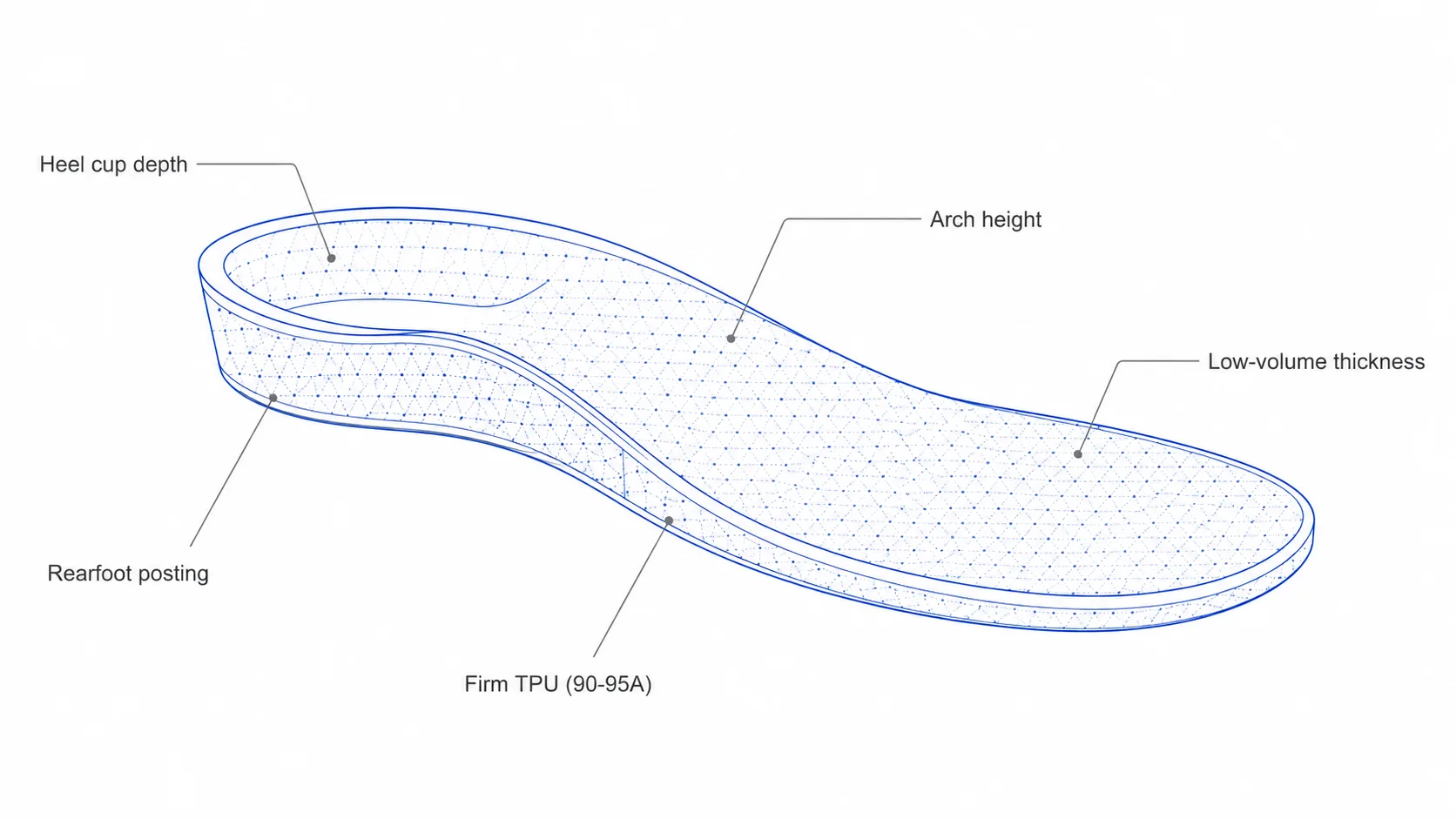
These two carry most of the work. Arch height, matched to the foot and aligned to where the arch actually sits, is what stops the inward roll. A deep heel cup locks the rearfoot in place so it does not wander — the foundation for staying centered. Both can be set differently for the left and right foot, which matters because pronation is often asymmetric.
Low-volume thickness
This is the lever that is special to skiing. A ski boot has very little internal volume, so a footbed that is too thick changes the fit, cramps the foot, and can cut circulation — a real concern in the cold. The goal is a thin, low-volume shell that adds support without stealing space. Keeping thickness inside the parameter set lets the design stay supportive and still fit the boot.
Posting
A small amount of rearfoot posting — wedged geometry under the heel — can bias how the foot loads and help a foot that rolls in. It is a conservative adjustment. Posting and alignment in skiing also interact with canting at the boot level, which is a bootfitter's job, not a footbed parameter; a footbed should support the foot, not try to re-align the whole stance.
Firm TPU
Material is part of the design. A ski footbed should be firm — typically a harder TPU such as 90A or 95A — so it holds its shape and transmits input to the boot rather than compressing under load. Softer, cushier material is the wrong choice here; it defeats the support the footbed exists to provide. For how durometer behaves, see understanding insole design parameters.
Where Ergono3D fits — and where a bootfitter does.
This is the most useful boundary to draw clearly, because they are not competitors — they do different jobs.
Ergono3D designs the footbed. It turns a guided profile into a per-foot, low-volume, firm parametric footbed and exports a print-ready STL. Its real advantage over a molded footbed is iteration: if the first version sits a little high under the arch or the heel cup feels too deep after a day on snow, you adjust a parameter and print again. Given that even shop-made custom footbeds are sometimes poorly shaped, being able to refine the design is the point, not a side benefit.
A bootfitter fits the boot. The skill of a good bootfitter — reading your stance, your biomechanics, and how you actually ski — is as important as any single footbed, and they handle things a footbed cannot: shell punching and grinding, liner work, and canting to align the whole leg. A footbed is one input into that larger job.
So the honest framing is not "Ergono3D instead of a bootfitter." It is: Ergono3D is a fast, iterable way to get a per-foot footbed, and a bootfitter is the right call for shell work, alignment, and complex or painful fits. Many skiers will use a supportive footbed and never need more; some need the full bootfitting treatment. For the broader custom-versus-pre-made logic, see are custom insoles worth it? and the pillar on why one insole design does not fit every activity.
What each option costs.
Price is not the only factor, and what you pay for differs a lot between options.
| Option | What you pay | Per-foot tuning | Iteration | Best fit |
|---|---|---|---|---|
| Stock footbed (in the boot) | Included | No | — | Almost nobody — replace it |
| Cut-to-fit / off-the-shelf (Sidas, Superfeet, SOLE) | Brand retail price | No (arch bucket) | Buy another | Many skiers; neutral feet; first upgrade |
| Ergono3D custom 3D printed footbed | Design credits + your print* | Yes (per foot, parametric) | Re-parameterise and reprint | Unusual or asymmetric arches; iterating after ski days |
| Bootfitter molded custom footbed | Shop price, usually including the fitting | Yes (fitter-led) | Return visit | Complex fits; part of full bootfitting; pain or alignment work |
*The design is paid for with Ergono3D credits (see current pricing); an STL you have already paid for can be downloaded again at no charge. The print is on you: TPU filament (estimate it from your slicer's weight estimate and your filament price), printer, failed prints, electricity, and your time. Footbed prices vary by brand and region, and a bootfitter's price depends on what the fitting includes.
The reason iteration matters so much in skiing is that the right footbed is often found, not guessed. You support the arch, ski on it, and learn whether it sits right. With a molded footbed, a second attempt is another paid visit. With a parametric design, it is a parameter nudge, a new export, and a reprint.
How to 3D print a ski boot footbed.
The loop is the same as any Ergono3D insole, with two ski-specific emphases: keep it thin, and print it firm.
- Answer the guided survey. Foot shape, arch type, any left-right difference, and how the boot feels now — heel lift, arch fatigue, foot rolling, pressure points.
- Tune the ski parameters. Arch height and heel cup depth for support, a low-volume thickness so it fits the boot, conservative rearfoot posting, and a firm TPU per foot.
- Export the STL. Ergono3D exports a print-ready file for each foot.
- Print thin and firm. Use a firm TPU such as 90A or 95A and keep the profile low; print on any FDM printer that handles flexible filament.
- Fit, ski, iterate. Fit it in the boot, ski on it, then adjust arch height, heel cup, or thickness and reprint if needed.
The full print walkthrough — slicer settings, TPU handling, and finishing — is in how to make your own custom insoles at home. The same per-foot approach applies to other feet and activities, including custom insoles for flat feet and custom arch support insoles.
Answer a short guided survey about your feet and your boots. Ergono3D turns it into adjustable parameters — arch height, heel cup depth, low-volume thickness, firm TPU — per foot, and exports a print-ready STL. Free preview available. For shell work or alignment, see a bootfitter.
Is a custom ski footbed worth it for you?
The honest answer is that it depends — and the ski world is refreshingly blunt about this.
Start with a quality off-the-shelf footbed if your feet are roughly neutral and symmetric, you have no real pain, and you just want to ditch the useless stock footbed. A cut-to-fit option is enough for a lot of skiers.
Go custom (Ergono3D) if off-the-shelf footbeds keep missing your arch, your two feet are noticeably different, your arch is unusually high or low, or you want to refine the support after skiing on it — without booking a new molded footbed each time.
See a bootfitter if you have boot pain, pressure points, alignment issues, or a boot that simply does not fit — those need shell work, canting, and a fitter's assessment, which a footbed alone cannot provide.
A footbed will not turn a bad-fitting boot into a good one, and it will not, on its own, make you a better skier. What a well-shaped, well-fitted footbed can do is keep your foot supported and centered so the boot you have works the way it should — and a parametric, reprintable design makes "well-shaped" easier and faster to dial in.
FAQs about custom ski boot footbeds.
Do ski boots need custom footbeds?
Not every skier needs a custom footbed, but most stock footbeds do very little — manufacturers invest almost nothing in them and assume you will replace them. A supportive footbed helps the foot stay centered and stable inside the rigid shell. Many skiers do well with a quality off-the-shelf or cut-to-fit footbed; custom becomes worth it when the arch is unusual, the feet differ left to right, or off-the-shelf options keep missing the support.
What is the difference between a ski boot footbed and an insole?
In skiing the two terms are used interchangeably — both mean the supportive layer beneath the foot inside the boot. "Footbed" is the more common term in the ski world, but it refers to the same thing as an insole or insert. The important distinction is not footbed versus insole, it is stock versus custom: whether the support is generic or tuned to the individual foot.
What does a ski boot footbed actually do?
Inside a rigid ski boot the footbed is not there for cushioning — the shell already protects the foot. Its job is to support the arch, stabilize the heel, and distribute pressure evenly so the foot stays centered. That helps control the inward roll (pronation), keeps weight balanced, and makes it easier to move cleanly from edge to edge with consistent pressure through the turn.
How much do custom ski boot footbeds cost?
It depends on the shop, the region, and what the fitting includes: a bootfitter's molded footbed is usually priced as part of a fitting service, and cut-to-fit drop-in footbeds sell at each brand's retail price. For a footbed designed through Ergono3D, you pay for the design with credits (see pricing) and print it yourself — TPU filament, printer, failed prints, electricity, and your time; an STL you have already paid for can be downloaded again at no charge.
How does Ergono3D make a custom ski footbed?
Ergono3D is a custom footbed design workflow. The skier answers guided questions about foot shape, use, and how the boot feels; Ergono3D turns those into parametric controls — arch height, heel cup depth, a low-volume thickness for the tight boot, posting, and a firm TPU — set independently per foot, and exports a print-ready STL. The skier prints it firm and thin, fits it, skis on it, and can return to re-parameterise and reprint.
Do I still need a bootfitter if I use a custom footbed?
A footbed is only one part of ski boot fit. A professional bootfitter analyzes your stance and biomechanics and handles shell work, canting, and complex fit problems that a footbed alone cannot solve. Ergono3D designs the footbed; it does not replace a bootfitter. For pain, alignment issues, or a boot that fits poorly, see a qualified bootfitter.
Related: custom insoles for flat feet · custom arch support insoles · why one insole does not fit every activity.